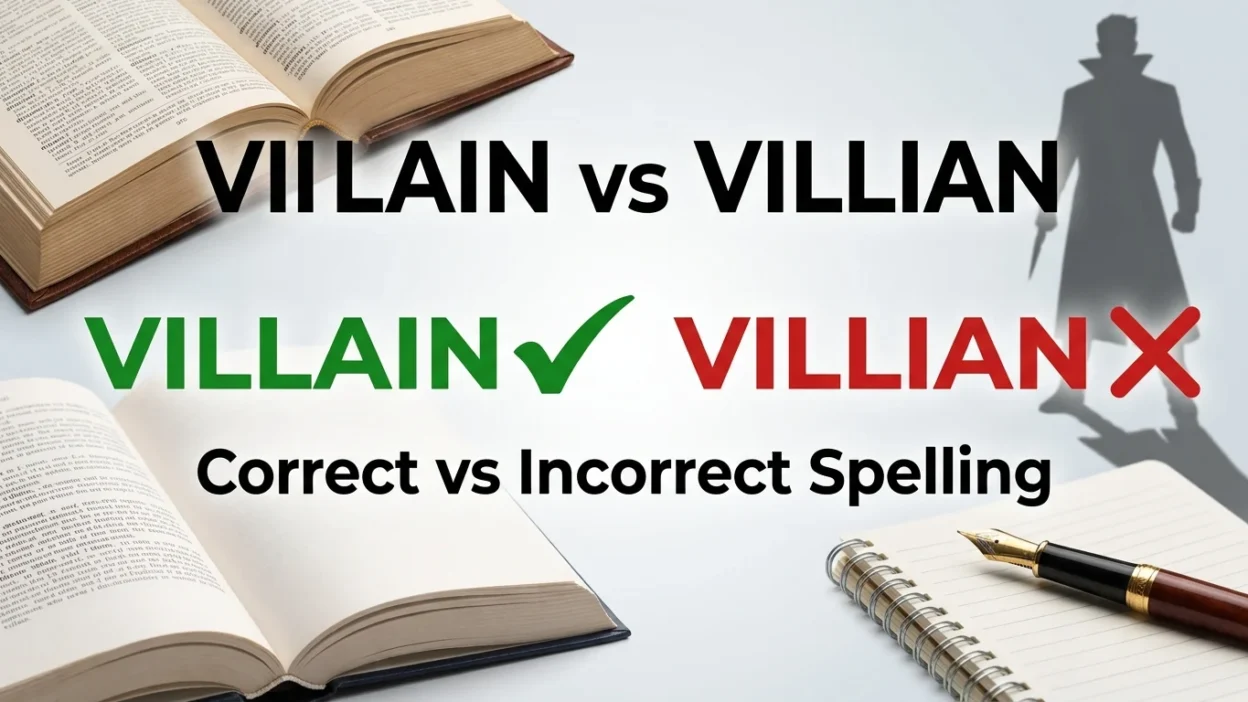
Are you unsure whether the correct spelling is villain or villian? The correct standard English spelling is villain, with the letters -lain in the middle. Villian is a common spelling mistake and is not the standard form.
The word villain is a noun used for a wicked, harmful, or evil person, especially a character who causes trouble or opposes the hero in a story. It can also be used more generally for a person who behaves badly or deliberately causes harm. You will commonly see the word in phrases such as movie villain, comic-book villain, main villain, and fictional villain.
Because the letters i, l, a, and n can be easy to rearrange, many learners accidentally write villian instead of villain. This article explains the difference clearly and shows you how to remember the correct spelling.
Quick Answer
Villain is the correct spelling. It means an evil, cruel, or harmful person, especially a character who opposes the hero in a story. Villian is a common misspelling and should not be used in standard English. Remember the correct letter order: V-I-L-L-A-I-N.
Why Do People Confuse It?
People often confuse villain and villian because the two spellings contain almost the same letters.
The problem is mainly the order of the letters in the middle:
villain → V-I-L-L-A-I-N
villian → V-I-L-L-I-A-N
Notice that villain has ai after the double l, while villian incorrectly changes that order to ia.
This kind of spelling mistake is common because English words do not always follow pronunciation exactly. The ending of villain may also make the spelling less obvious for learners.
The best approach is to memorize the complete spelling rather than trying to spell the word only from its pronunciation.
First Word: Villain
What Does Villain Mean?
Villain is a noun that usually refers to a person who is evil, harmful, cruel, or morally bad.
The word is especially common in stories, films, novels, comics, and television shows.
Examples:
- The villain planned to destroy the city.
- The hero finally defeated the villain.
- The movie has a memorable villain.
It can also be used in everyday language for a person who behaves badly.
Example:
- The dishonest businessman was portrayed as the villain of the story.
Villain in Fiction
In fiction, a villain is typically the character who creates conflict and works against the hero or other main characters.
Examples of common fictional roles include:
- the main villain
- the evil villain
- the movie villain
- the comic-book villain
- the story’s villain
A villain may be dangerous, dishonest, cruel, manipulative, or selfish, depending on the story.
Villain in Everyday English
The word can also be used outside fiction.
Example:
- He became the villain after betraying his friends.
In this kind of sentence, villain is often used figuratively to describe someone who is blamed for causing serious problems or behaving badly.
Second Word: Villian
Is Villian Correct?
No. Villian is not the standard spelling of the word.
If you mean an evil character or harmful person, write villain.
Incorrect:
The villian escaped from the castle.
Correct:
The villain escaped from the castle.
Why Does Villian Look Correct?
The incorrect form villian looks believable because the letters are very similar to the correct spelling. The mistake happens when the a and i are placed in the wrong order.
Remember:
villain = -lain
Not:
villian = -lian
Comparison Table
| Feature | Villain | Villian |
|---|---|---|
| Standard English spelling | Yes | No |
| Meaning | Evil or harmful person | Misspelling of villain |
| Used in fiction | Yes | No |
| Used in everyday English | Yes | No |
| Suitable for academic writing | Yes | No |
| Suitable for professional writing | Yes | No |
| Correct letter order | V-I-L-L-A-I-N | Incorrect |
When to Use Each
When to Use Villain
Use villain when referring to:
- An evil character in a story
- An enemy of a hero
- A cruel or harmful person
- Someone blamed for causing serious trouble
- A fictional antagonist who is morally bad
Examples:
- The villain stole the treasure.
- The hero confronted the villain.
- She played the villain in the film.
- Everyone blamed him as the villain.
When Not to Use Villian
Do not use villian in standard English writing.
If you are writing an essay, story, article, review, school assignment, or professional document, use:
villain
not:
villian
10+ Examples of Villain
Here are practical examples showing the correct spelling and usage.
- The villain escaped before the police arrived.
- The hero finally defeated the villain.
- The movie’s villain was more interesting than the main character.
- She played the role of a powerful villain.
- The villain secretly planned to take control of the kingdom.
- Everyone in the story feared the villain.
- The comic-book villain had a complicated background.
- The hero discovered the villain’s secret plan.
- The author created a memorable villain for the novel.
- The audience immediately understood that he was the villain.
- The villain tried to destroy the hero’s reputation.
- The story presents the businessman as the main villain.
- The children were excited to see the movie’s villain.
- The villain disappeared before the final battle.
- He was portrayed as the villain because of his betrayal.
These examples show that villain can be used for fictional characters as well as figurative descriptions of real people.
Common Mistakes
Mistake 1: Writing Villian
Incorrect:
The villian was defeated at the end.
Correct:
The villain was defeated at the end.
The correct middle spelling is -lain.
Mistake 2: Mixing Up AI and IA
The most common spelling error is reversing the letters a and i.
Correct:
villain
Incorrect:
villian
Pay special attention to the sequence:
ai
Mistake 3: Confusing Villain With Villainous
Villain is a noun.
Example:
- The villain escaped.
Villainous is an adjective meaning evil or wicked.
Example:
- The character displayed villainous behavior.
Do not use the two words in the same way.
Mistake 4: Confusing Villain With Antagonist
A villain is usually a morally bad character.
An antagonist is a character or force that opposes the protagonist. An antagonist does not always have to be evil.
For example, a rival, government system, natural force, or misunderstood character could function as an antagonist without being a villain.
Mistake 5: Confusing Villain With Criminal
A villain can be a criminal, but the meanings are not identical.
A criminal is someone who commits a crime.
A villain is someone portrayed as evil, harmful, cruel, or morally bad.
A fictional villain may not always commit a specific crime.
Memory Trick
The easiest way to remember villain is to focus on the middle:
VILLAIN
Think:
V-I-L-L-A-I-N
The important part is:
L-A-I
not:
L-I-A
A useful memory sentence is:
The villain has an AI in the middle.
This gives you the correct letter order:
vill + ai + n
Once you remember AI in the middle, it becomes much easier to avoid villian.
American vs British English
The spelling villain is the same in both American and British English.
American English:
- villain
- villains
- villainous
British English:
- villain
- villains
- villainous
There is no standard American-British spelling difference for this word.
The pronunciation can vary slightly between accents, but the written form remains villain.
Similar Words
Several words are related to villain, but they do not all have exactly the same meaning.
Antagonist
An antagonist is a person, character, or force that opposes the protagonist.
Example:
- The antagonist challenges the hero throughout the novel.
An antagonist is not always evil.
Nemesis
A nemesis is a powerful opponent or someone who repeatedly causes problems for another person.
Example:
- The detective finally confronted his old nemesis.
Evildoer
An evildoer is someone who does very bad or harmful things.
Example:
- The story follows a hero who fights an evildoer.
Criminal
A criminal is a person who commits a crime.
Example:
- The criminal was arrested by the police.
Adversary
An adversary is an opponent or enemy.
Example:
- The hero faced a dangerous adversary.
Scoundrel
A scoundrel is a dishonest or unpleasant person.
Example:
- The novel’s scoundrel cheated everyone around him.
Enemy
An enemy is someone who is opposed to another person or group.
Example:
- The hero’s enemy returned in the final chapter.
These words overlap with villain, but they are not perfect substitutes in every sentence.
Villain vs Antagonist
This is an important difference for students and writers.
A villain is usually a character who is morally bad or intentionally harmful.
An antagonist is simply the character or force opposing the protagonist.
For example, in a story:
- The villain wants to destroy the hero.
- The antagonist blocks the hero’s goal.
A story can have an antagonist who is not actually evil.
This distinction is useful when analyzing novels, films, plays, and other stories.
Villain vs Hero
The words villain and hero are often presented as opposites in traditional storytelling.
A hero is generally the central character who faces challenges and is portrayed positively.
A villain is generally the character who creates major conflict and is portrayed negatively.
Examples:
- The hero saved the village from the villain.
- The story follows a battle between the hero and the villain.
Modern stories can make these roles more complicated, but the basic distinction is still common.
Villain vs Villainous
These words are related but belong to different grammatical categories.
Villain is a noun.
Example:
- The villain frightened everyone.
Villainous is an adjective.
Example:
- The character showed villainous behavior.
The noun names the person, while the adjective describes behavior or characteristics.
Plural Form of Villain
The plural form of villain is:
villains
Example:
- The film features several villains.
The spelling is straightforward:
villain → villains
Do not change the spelling to villians.
Incorrect:
The story has three villians.
Correct:
The story has three villains.
Related Word Forms
Understanding related forms can help improve vocabulary.
| Word | Part of Speech | Meaning |
|---|---|---|
| Villain | Noun | An evil or harmful person |
| Villains | Noun, plural | More than one villain |
| Villainous | Adjective | Evil or characteristic of a villain |
| Villainy | Noun | Wicked or criminal behavior |
Examples:
- The villain escaped.
- The villains worked together.
- His villainous plan failed.
- The novel explores political villainy.
How to Choose the Right Spelling
The rule is simple.
Use Villain
Use villain whenever you mean an evil, cruel, harmful, or antagonistic person, especially in a story.
Avoid Villian
Villian is a spelling mistake, so do not use it in standard English writing.
Remember AI
The middle of the correct word contains:
AI
So:
vill + ai + n = villain
This small memory trick can make the spelling much easier.
Final Verdict
The correct spelling is villain.
Villian is a common misspelling caused by reversing the a and i in the middle of the word. When you mean an evil or harmful person, especially a character who opposes the hero in a story, use villain.
Remember the correct spelling:
V-I-L-L-A-I-N
The key is the AI in the middle. Once you remember that letter order, you can easily avoid writing villian.
FAQs
Is villain or villian correct?
Villain is correct. Villian is a misspelling.
How do you spell villain correctly?
The correct spelling is V-I-L-L-A-I-N.
What does villain mean?
A villain is an evil, cruel, harmful, or morally bad person, especially a character who opposes the hero in a story.
Is villian a real word?
Villian is not the standard spelling of the English word villain. It is normally considered a misspelling.
What is the plural of villain?
The plural is villains.
Example:
The movie contains several villains.
What is the difference between a villain and an antagonist?
A villain is generally a morally bad character, while an antagonist is any character or force that opposes the protagonist. An antagonist is not necessarily evil.
What is the adjective form of villain?
The adjective is villainous.
Example:
The character had a villainous personality.
What is the noun for evil behavior by a villain?
The noun villainy refers to wicked, cruel, or criminal behavior.
Remember This
The correct word is:
VILLAIN ✅
The incorrect spelling is:
VILLIAN ❌
Focus on the middle letters:
vill + ai + n
Remember AI, and you will remember the correct spelling of villain.
Conclusion
When comparing villain vs villian, the correct standard English spelling is villain. It refers to an evil, harmful, cruel, or morally bad person, especially a character who creates conflict and opposes the hero in a story. The spelling villian is a common mistake caused by reversing the a and i in the middle of the word.
The easiest way to remember the correct spelling is to focus on AI: V-I-L-L-A-I-N. The same spelling is used in both American and British English. Whether you are writing a story, reviewing a movie, completing a school assignment, or simply improving your vocabulary, always choose villain, not villian.

Gabriel John is a language enthusiast and grammar writer at Synolexes. He creates clear, practical content on English grammar, vocabulary, and writing, helping learners improve communication skills with confidence.