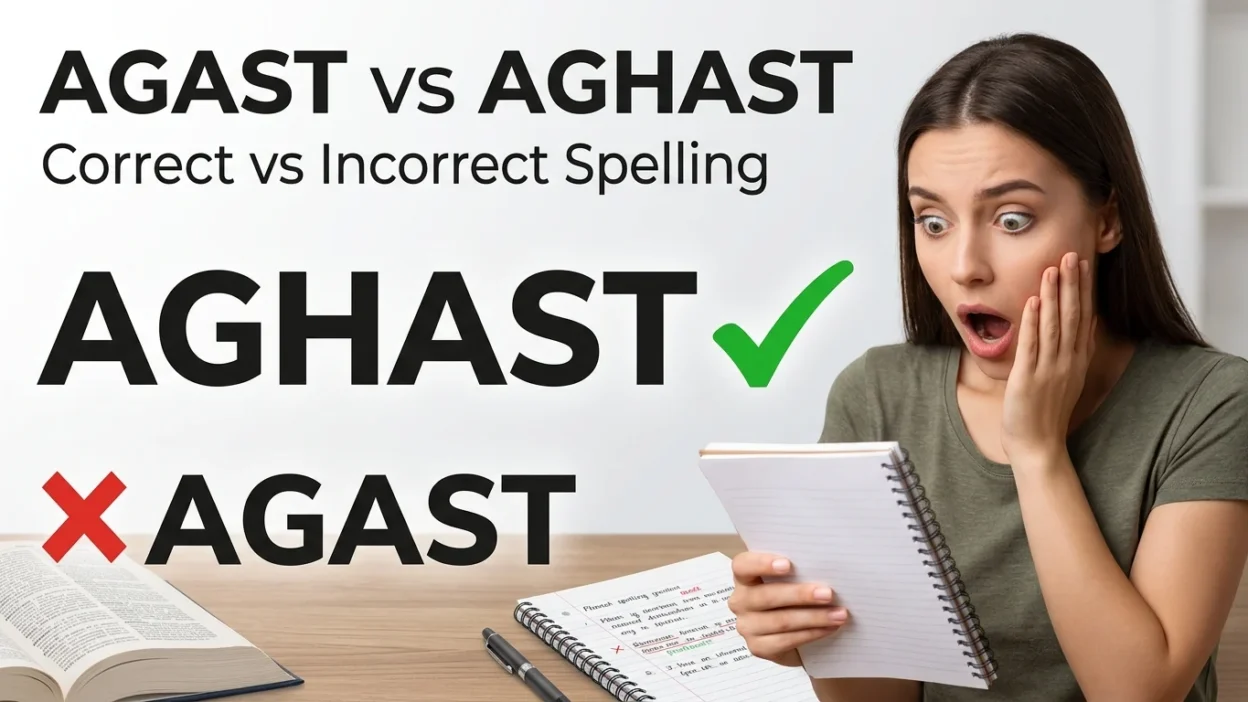
Are you confused about agast vs aghast? These spellings look almost identical, but only one is the standard modern English form. The correct word is aghast, and it is used when someone is suddenly filled with shock, horror, or strong surprise.
Aghast is an adjective that describes a person who is deeply shocked or horrified by something unexpected or disturbing. Dictionaries such as Cambridge and Oxford define it in connection with strong shock, horror, and surprise.
The spelling agast is not the standard modern spelling of this adjective. Interestingly, Oxford notes that aghast developed from the older verb agast, while the spelling with gh became established over time.
Quick Answer
Aghast is the correct standard modern English spelling. It means extremely shocked, horrified, or suddenly filled with strong surprise. Agast is not the normal modern spelling, although it has historical roots connected to the word. For contemporary writing, use aghast, especially in expressions such as aghast at something.
Why Do People Confuse It?
The confusion between agast and aghast mainly comes from the unusual spelling of aghast.
The combination gh can be confusing because English uses it in several different ways. In words such as ghost, it is pronounced as a consonant sound, while in words such as though, it is not pronounced at all. This makes aghast look more complicated than it sounds.
Another reason is historical spelling. Oxford explains that aghast comes from the obsolete verb agast, meaning to frighten, and that the spelling with gh became general around the 1700s, probably influenced by ghost and ghastly.
So, although agast has a historical connection to the word, aghast is the spelling you should use in modern English.
First Word: Agast
Is Agast Correct?
For ordinary modern English, agast is not the standard spelling of the adjective meaning shocked or horrified.
If you are writing an essay, article, email, story, or school assignment, use aghast.
Incorrect for modern standard usage:
She was agast at the news.
Correct:
She was aghast at the news.
Why Does Agast Exist?
The spelling agast has historical importance. Oxford traces aghast back to the obsolete verb agast, which came from Old English and was associated with frightening or terrifying someone. The spelling later developed into aghast.
That history explains why you may occasionally encounter agast in discussions of the word’s origin or in historical material. It does not make agast the preferred modern spelling.
Should You Use Agast Today?
Generally, no.
For present-day standard English, choose aghast.
Second Word: Aghast
What Does Aghast Mean?
Aghast means suddenly filled with strong feelings of shock, horror, or worry. Cambridge defines it as being suddenly filled with strong feelings of shock and worry, while Oxford describes it as being filled with horror and surprise.
Examples:
- She was aghast at the terrible news.
- He looked aghast when he saw the damage.
- We were aghast at the unexpected result.
Aghast as an Adjective
Aghast is an adjective, but it is normally used after a linking verb or in structures such as aghast at.
Examples:
- She was aghast.
- They stood aghast.
- He looked aghast.
- She was aghast at the decision.
Oxford labels aghast as an adjective and gives examples such as someone looking aghast or standing aghast at something shocking.
Comparison Table
| Feature | Agast | Aghast |
|---|---|---|
| Standard modern English | No | Yes |
| Common modern usage | Very rare | Common enough in formal/literary contexts |
| Meaning | Historical form related to fright | Shocked, horrified, or deeply surprised |
| Modern dictionary adjective | Not the normal form | Yes |
| Suitable for academic writing | No | Yes |
| Suitable for professional writing | No | Yes |
| Typical pattern | Historical usage | aghast at something |
| Recommended spelling | Avoid | Use |
When to Use Each
When to Use Aghast
Use aghast when someone reacts with strong shock, horror, or disbelief.
Examples:
- She was aghast at the amount of damage.
- The audience looked aghast.
- He stood aghast at what had happened.
- They were aghast to discover the mistake.
The word is especially useful when ordinary words such as surprised or shocked do not fully express the intensity of the reaction.
When Agast May Appear
You may encounter agast when reading about the historical development of aghast because it was the form of an older verb. Oxford specifically identifies it as an obsolete verb connected with the origin of aghast.
For current standard writing, however, aghast is the form to choose.
10+ Examples of Aghast
- She was aghast at the unexpected announcement.
- He looked aghast when he saw the broken window.
- The parents were aghast at the damage to the house.
- I was aghast to hear what had happened.
- They stood aghast as the storm grew stronger.
- The teacher looked aghast at the condition of the classroom.
- She was completely aghast at the final cost.
- The audience sat aghast after hearing the shocking news.
- He seemed aghast at the sudden change.
- We were aghast when the results were announced.
- The visitors were aghast at the sight before them.
- She stared at him, aghast at his words.
- The workers were aghast by the scale of the damage.
- He stood aghast at the unexpected discovery.
- Everyone was aghast at how quickly the situation changed.
These examples reflect the standard meaning of aghast as a strong emotional reaction to something shocking or disturbing.
Common Mistakes
Mistake 1: Writing Agast
Incorrect:
He was agast at the news.
Correct:
He was aghast at the news.
The modern adjective contains gh.
Mistake 2: Confusing Aghast With Aghost
Some learners may accidentally add an o because of the spelling ghost.
Incorrect:
She was aghost at the sight.
Correct:
She was aghast at the sight.
Mistake 3: Using Aghast as a Regular Verb
Aghast is an adjective, not a normal verb.
Incorrect:
The news aghasted her.
Better:
The news shocked her.
Or:
She was aghast at the news.
Mistake 4: Using Aghast for Mild Surprise
Aghast generally expresses a strong reaction involving shock, horror, or serious surprise. Cambridge describes it as being suddenly filled with strong feelings of shock and worry.
For a small surprise, words such as surprised or amazed may be more appropriate.
Compare:
- I was surprised by the gift.
- I was aghast at the terrible news.
Mistake 5: Forgetting the Preposition At
A common structure is:
aghast at something
Examples:
- She was aghast at the news.
- He was aghast at the decision.
- They were aghast at the damage.
Learning this pattern makes the word easier to use naturally.
Memory Trick
A simple way to remember aghast is to connect it with ghastly.
Both words contain gh, and both can be associated with something frightening or disturbing.
Remember:
aghast = shocked or horrified
You can also break the spelling visually into:
A + GHAST
The important part is remembering the GH.
Do not write:
agast
Write:
aghast
Another useful method is to memorize the common phrase:
aghast at
For example:
She was aghast at the news.
American vs British English
The spelling aghast is the same in both American and British English. The main difference is pronunciation.
Cambridge gives the British pronunciation as /əˈɡɑːst/ and the American pronunciation as /əˈɡæst/.
Oxford similarly gives both British and American pronunciations for the word.
So the spelling rule is simple:
British English: aghast
American English: aghast
The written form does not change.
Similar Words
Several English words can be used in situations similar to aghast, although their meanings are not always exactly the same.
Shocked
Means strongly surprised or upset by something unexpected.
Example:
She was shocked by the news.
Horrified
Means filled with strong fear, disgust, or shock.
Example:
They were horrified by what they saw.
Appalled
Means extremely shocked and disturbed, often because something seems very bad or unacceptable.
Example:
She was appalled by the behavior.
Stunned
Means so surprised or shocked that you have difficulty reacting immediately.
Example:
He was stunned by the announcement.
Astonished
Means extremely surprised.
Example:
I was astonished by the result.
Astounded
Means extremely surprised or shocked. Oxford lists astound among words associated with strong surprise or shock.
Terrified
Means extremely frightened.
Example:
The child was terrified by the noise.
Among these words, aghast often suggests a combination of shock, horror, and disbelief rather than simple surprise. Cambridge’s thesaurus groups it with words such as horrified, shocked, appalled, and stunned.
Aghast vs Shocked
These words can often appear in similar situations, but aghast is more expressive and often more literary or formal.
Compare:
- She was shocked by the news.
- She was aghast at the news.
Shocked is a very common everyday word. Aghast creates a stronger image of someone being deeply disturbed, horrified, or stunned.
Aghast vs Horrified
Horrified usually emphasizes fear, disgust, or extreme distress.
Aghast emphasizes a sudden reaction of shock and horror.
Examples:
- She was horrified by the violence.
- She stood aghast when she saw the scene.
The words overlap, but aghast often describes the immediate reaction or expression.
Aghast vs Astonished
Astonished mainly means extremely surprised.
Aghast usually carries a more negative emotional feeling, such as shock, horror, or alarm. Cambridge’s definitions specifically connect aghast with unpleasant shock and worry.
Compare:
- I was astonished by her talent.
- I was aghast at the terrible mistake.
The first is strong surprise, while the second involves distress or horror.
Aghast vs Appalled
Appalled and aghast are close in meaning.
Appalled often suggests that something is extremely unacceptable, shocking, or disturbing.
Aghast emphasizes the person’s immediate shocked or horrified reaction.
Examples:
- She was appalled by the cruelty.
- She stood aghast at the scene.
How to Use Aghast Correctly
Aghast is most commonly used in these patterns:
Be Aghast
- She was aghast.
- They were aghast.
Look Aghast
- He looked aghast.
Stand Aghast
- She stood aghast.
Aghast at Something
- We were aghast at the news.
- He was aghast at the result.
Aghast to Discover or Learn Something
- She was aghast to discover the truth.
- He was aghast to learn what had happened.
These structures will help you use the word naturally.
Final Verdict
The correct standard modern English spelling is aghast.
Agast has an important historical connection to the word, but it is not the normal modern spelling. Oxford explains that aghast developed from the obsolete verb agast, with the spelling containing gh becoming established later.
So, when you want to describe someone who is deeply shocked, horrified, or suddenly filled with strong surprise, use aghast.
Correct:
She was aghast at the news.
Incorrect for modern standard usage:
She was agast at the news.
FAQs
Is agast or aghast correct?
Aghast is the correct standard modern English spelling.
What does aghast mean?
Aghast means suddenly filled with strong feelings of shock, horror, or worry.
Is agast a word?
Agast has historical significance as an obsolete verb connected to the origin of aghast, but it is not the standard modern spelling of the adjective used today.
What is an example of aghast?
She was aghast at the terrible news.
Is aghast an adjective?
Yes. Aghast is an adjective describing someone who is extremely shocked or horrified.
Do American and British English spell aghast differently?
No. The spelling is aghast in both American and British English. The pronunciation differs between the two varieties.
What is a synonym for aghast?
Depending on context, synonyms include shocked, horrified, appalled, stunned, astonished, and astounded.
What preposition is used with aghast?
The common structure is aghast at.
Example:
She was aghast at the result.
Remember This
The easiest rule is:
Aghast = correct
Agast = historical form, not the normal modern spelling
Remember the GH in aghast and connect it with ghastly.
Also remember the common pattern:
aghast at something
Example:
He was aghast at the news.
Conclusion
When comparing agast vs aghast, the correct modern English spelling is aghast. The word describes someone who is suddenly and deeply shocked, horrified, or disturbed by something unexpected. It is an adjective commonly used in structures such as was aghast, looked aghast, and aghast at something.
Although agast has a historical connection to the word and was once used as an older verb, aghast is the established spelling in modern English. Whether you are writing an essay, article, story, email, or formal document, choose aghast. Remember the gh, and you will have the correct spelling.