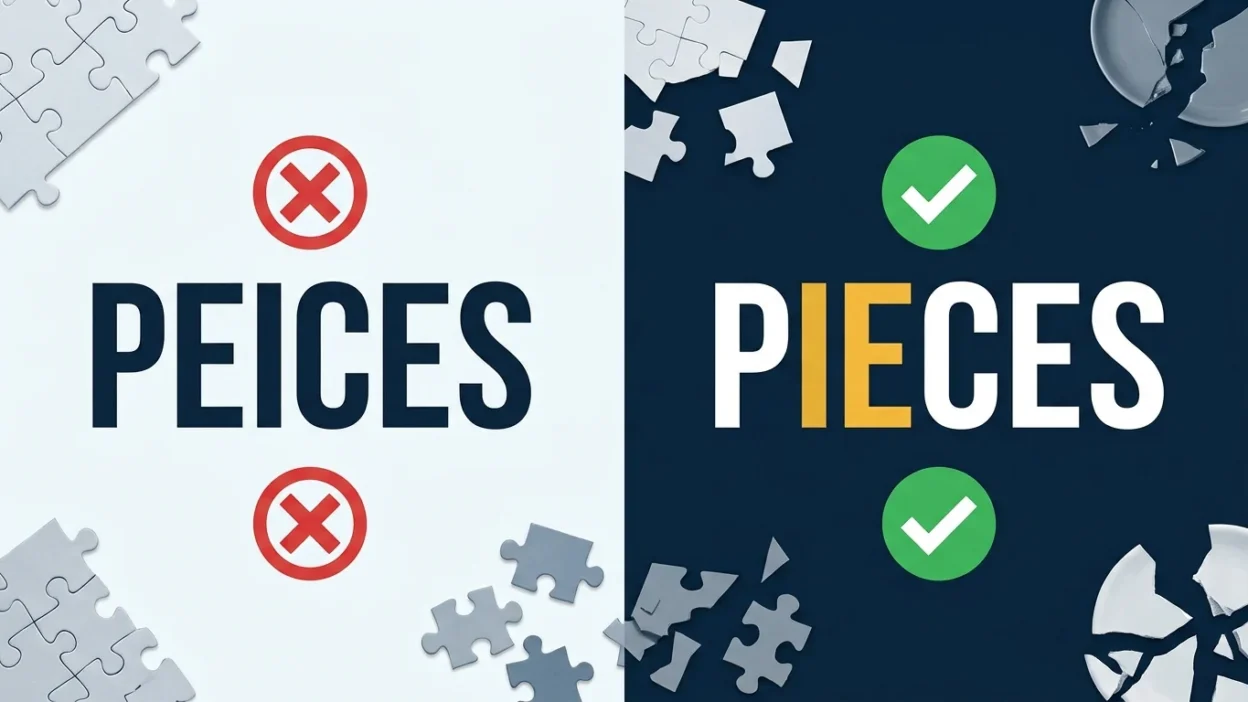
English spelling can be confusing, especially when a small change in letter order creates an incorrect word. Peices vs pieces is a common spelling mistake because the letters i and e are often placed in the wrong order.
The correct spelling is pieces. The word pieces is the plural form of piece, meaning separate parts, portions, or individual items that make up something larger. Peices is not the standard spelling and should generally be corrected to pieces.
Knowing the difference is useful for students, ESL learners, writers, and anyone who wants to improve everyday English spelling. Once you remember the correct letter order, this mistake becomes much easier to avoid.
Quick Answer
Pieces is the correct spelling. Peices is an incorrect spelling caused by reversing the i and e. Use pieces when referring to two or more parts, portions, or individual items.
Why People Confuse Peices and Pieces
The words peices and pieces look very similar. The only difference is the order of two letters.
- Pieces = correct
- Peices = incorrect
Many people remember that English words sometimes contain ie or ei, which can make the spelling confusing. In piece, however, the correct sequence is ie.
The plural form simply adds s:
piece → pieces
The First Word: Pieces
Pieces is the correct plural form of piece.
A piece can mean a part of something, an individual item, a portion of food, a work of art, or an object considered separately from others.
For example:
- I found several pieces of paper.
- She bought two pieces of cake.
- The puzzle has many pieces.
- He collected pieces of information.
When there is more than one piece, use pieces.
Meaning of Pieces
The word pieces can have different meanings depending on context.
Parts of something:
- The machine broke into several pieces.
Individual items:
- The shop sells handmade pieces.
Portions of food:
- We ordered three pieces of chicken.
Works of art or writing:
- The magazine published several pieces by young writers.
Parts or fragments:
- The glass fell into small pieces.
The Second Word: Peices
Peices is generally an incorrect spelling of pieces.
The mistake happens when the letters i and e are reversed:
- Incorrect: peices
- Correct: pieces
If you are writing about parts, portions, fragments, or individual items, use pieces.
Why Peices Looks Correct
The spelling peices may look reasonable because English has many words with different ie/ei patterns. However, the standard spelling of this word is always piece, and its plural is pieces.
Incorrect:
- The puzzle has fifty peices.
Correct:
- The puzzle has fifty pieces.
Peices vs Pieces Comparison Table
| Word | Correct? | Meaning | Example |
|---|---|---|---|
| Pieces | Yes | Plural of piece; parts or individual items | The puzzle has many pieces. |
| Peices | No | Incorrect spelling of pieces | The puzzle has many peices. |
When to Use Pieces
Use pieces whenever you mean two or more pieces.
Pieces as Parts
- The broken toy was scattered into pieces.
- The machine contains many small pieces.
Pieces as Portions
- She ate two pieces of fruit.
- We shared several pieces of cake.
Pieces as Individual Items
- The artist displayed her latest pieces.
- The store has some beautiful furniture pieces.
Pieces as Works
Pieces can also describe works of writing, music, or art.
- The pianist performed several difficult pieces.
- I read three interesting pieces in the magazine.
12 Examples of Pieces
- The child put the puzzle pieces together.
- The glass broke into several pieces.
- She cut the cake into eight pieces.
- I found two pieces of paper under the desk.
- The machine has many small pieces.
- We need a few more pieces to complete the puzzle.
- He collected pieces of old furniture.
- The artist displayed her latest pieces.
- The pianist practiced several musical pieces.
- They divided the chocolate into equal pieces.
- The story contains several interesting pieces of information.
- The workers replaced the damaged pieces.
Common Mistakes
Mistake 1: Writing Peices Instead of Pieces
Incorrect:
- I need all the peices.
Correct:
- I need all the pieces.
The correct order is pie, not pei.
Mistake 2: Adding the Plural to the Wrong Spelling
Incorrect:
- peice → peices
Correct:
- piece → pieces
Learn the singular form first, then add s.
Mistake 3: Confusing Piece With Peace
Piece and peace sound alike but have different meanings.
- Piece = a part or portion
- Peace = a state without conflict
Examples:
- I want a piece of cake.
- The countries finally achieved peace.
Memory Trick
A simple way to remember pieces is:
PIE + CES = PIECES
Think of the word pie. The beginning of pieces is spelled pie, not pei.
Remember:
piece → pieces
Not:
peice → peices
Another useful trick is to remember the phrase a piece of pie. Both piece and pie begin with pie.
American vs British English
There is no spelling difference between American and British English for this word.
Both American English and British English use:
- piece
- pieces
The spelling peices is generally considered incorrect in both varieties.
Similar Words
Several words can be confused with pieces because they have related meanings or similar spellings.
Parts
Parts means sections or portions of something.
- The machine has several parts.
Portions
Portions usually refers to amounts of food or other divided quantities.
- The restaurant served large portions.
Sections
Sections means separate areas or divisions of something.
- The book has five sections.
Fragments
Fragments are small broken or incomplete parts.
- They found fragments of glass.
Components
Components are individual parts that combine to form a larger system.
- The computer contains many components.
Piece vs Pieces
The difference between piece and pieces is simply singular versus plural.
| Form | Meaning | Example |
|---|---|---|
| Piece | One part or item | I need one piece. |
| Pieces | More than one part or item | I need several pieces. |
Remember that the spelling remains piece when you add the plural s:
piece → pieces
Final Verdict
Pieces is the correct spelling, while peices is generally incorrect.
Use pieces when referring to multiple parts, portions, fragments, works, or individual items. The most important spelling detail is the ie sequence:
PIECES ✅
PEICES ❌
A useful memory trick is to connect piece with pie. Once you remember that the word begins with pie, you can easily avoid the common peice/peices spelling mistake.
FAQs
Is peices a correct spelling?
No. Peices is generally an incorrect spelling. The correct spelling is pieces.
Is it pieces or peices?
The correct spelling is pieces. The letters i and e appear in the order ie.
What is the plural of piece?
The plural of piece is pieces.
How do you spell pieces correctly?
Spell it pieces: P-I-E-C-E-S.
Why is peices wrong?
Peices has the letters i and e in the wrong order. The correct spelling is pieces.
What does pieces mean?
Pieces is the plural of piece. It can refer to parts, portions, fragments, individual items, or works of art, writing, or music.
What is an example of pieces?
An example is: The puzzle has many pieces.
Is piece and peace the same?
No. Piece means a part or portion, while peace refers to a state of calm or freedom from conflict.
Remember This
- Pieces = correct spelling
- Peices = incorrect spelling
- Piece = singular
- Pieces = plural
- Remember PIE at the beginning: PIECES
The easiest rule is simple: when you mean multiple parts or items, write pieces, never peices.
Conclusion
The difference between peices vs pieces is easy to understand once you focus on the letter order. Pieces is the correct standard spelling and is the plural form of piece. Peices is a common spelling mistake and should be avoided in formal and everyday writing.
If you often confuse these spellings, remember the word pie. The correct word starts with pie, giving you pieces. With this simple memory trick and a little practice, you can confidently use the correct spelling in essays, emails, articles, and everyday communication.

Gabriel John is a language enthusiast and grammar writer at Synolexes. He creates clear, practical content on English grammar, vocabulary, and writing, helping learners improve communication skills with confidence.