
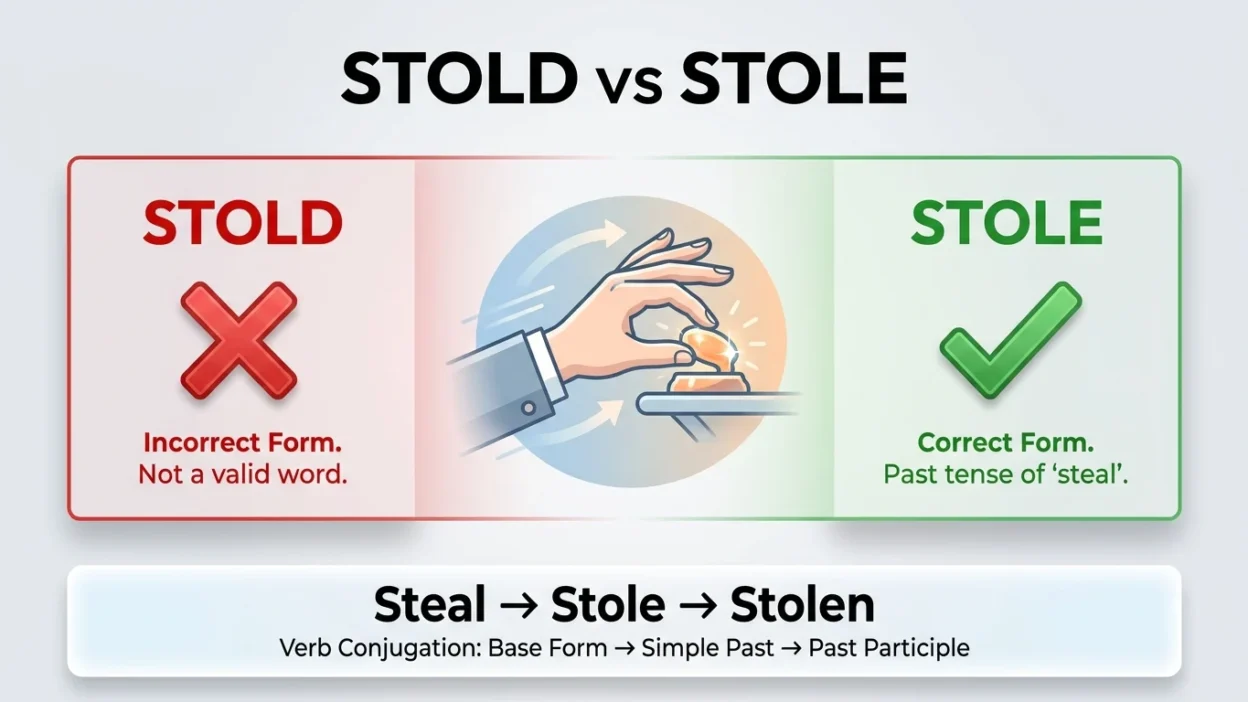
The difference between stold vs stole is simple: stole is the correct standard past tense of the verb steal, while stold is generally a misspelling in modern English. The verb steal means to take something that belongs to another person without permission. For example, She stole my phone is correct, while She stold my phone is incorrect.
People often confuse these words because English has many irregular verbs with different past-tense forms. Some verbs end in -ed, while others change their spelling completely. Although stold may look like a possible past-tense form, it is not the standard form of steal.
Understanding the difference between stold and stole can help you improve your spelling, write more accurately, and avoid common grammar mistakes. In this guide, you will learn the meaning of stole, why stold is incorrect in standard English, how to use stole in sentences, and how it differs from related words such as steal, stolen, and stealing.
Quick Answer: Stold vs Stole
Stole is correct, and stold is generally incorrect in standard English. Stole is the simple past tense of steal, meaning to take something without permission. For example, He stole my wallet yesterday is correct. The standard verb forms are steal, stole, and stolen.
Why Do People Confuse Stold and Stole?
People confuse stold and stole because English verbs do not all follow the same spelling rules. Regular verbs usually form the past tense by adding -ed, as in walk → walked. Irregular verbs, however, may change their vowels or use different forms.
For example:
- Speak → spoke
- Break → broke
- Choose → chose
- Steal → stole
Because words such as spoke and broke end in -oke, some learners may try to form the past tense of steal using a similar pattern or may assume stold is correct.
The important rule is that steal changes to stole in the simple past tense. It does not change to stold.
What Does Stold Mean?
Stold is generally a misspelling of stole when someone intends to use the past tense of steal.
In standard modern English, stold is not an accepted past-tense form of steal. You should avoid it in school assignments, professional writing, emails, and everyday communication.
Incorrect: Someone stold my bicycle yesterday.
Correct: Someone stole my bicycle yesterday.
Although readers may understand the intended meaning, using stole makes the sentence grammatically correct.
What Does Stole Mean?
Stole is the simple past tense of steal. It describes an action in which someone took something belonging to another person without permission.
Examples:
- Someone stole my bag.
- The thief stole a bicycle from the shop.
- He stole money from the drawer.
- Someone stole my idea and presented it as their own.
Stole can refer to physical objects, money, ideas, or other things that are taken dishonestly.
Example Sentences With Stole
- She stole a pen from the office.
- Someone stole my wallet on the bus.
- The thief stole a laptop from the store.
- He stole my favorite book.
- They stole the car during the night.
- Someone stole her phone at the concert.
- The employee stole money from the company.
- He stole the credit for someone else’s work.
- The boy admitted that he stole the toy.
- Someone stole our package from the doorstep.
Stold vs Stole: Comparison Table
| Feature | Stold | Stole |
|---|---|---|
| Standard spelling | Incorrect in this context | Correct |
| Base verb | Intended to be steal | Steal |
| Meaning | Intended meaning is taking something without permission | Took something without permission |
| Grammar | Nonstandard past-tense form | Simple past tense |
| Example | He stold my phone. | He stole my phone. |
| Recommended use | Avoid | Use in standard English |
When Should You Use Each Word?
1. When Should You Use Stold?
In standard modern English, you should not use stold as the past tense of steal.
Incorrect: The man stold my bag.
Correct: The man stole my bag.
If you are writing a sentence about an event that happened in the past, use stole.
2. When Should You Use Stole?
Use stole when describing a completed action in the past.
For physical objects:
- Someone stole my keys.
- The thief stole a valuable painting.
For money or property:
- He stole money from the cash register.
- Someone stole her bicycle.
For ideas or credit:
- The writer stole another author’s idea.
- He stole the credit for the team’s work.
For storytelling:
- The fox stole food from the farm.
- Someone stole the necklace while the guests were dancing.
What Are the Correct Forms of Steal?
The verb steal has three important forms that you should learn.
| Verb Form | Word | Example |
|---|---|---|
| Base form | Steal | Do not steal other people’s property. |
| Simple past | Stole | Someone stole my bag yesterday. |
| Past participle | Stolen | My bag has been stolen. |
| Present participle | Stealing | He was stealing food from the shop. |
| Third-person singular | Steals | The character steals a valuable ring. |
Remember that stole and stolen are different forms. Use stole for the simple past and stolen with helping verbs such as has, have, had, or in passive constructions.
Examples:
- Correct: She stole my phone.
- Correct: She has stolen my phone.
- Incorrect: She has stole my phone.
15 Examples of Stold vs Stole
The following examples show the incorrect form and its correct replacement.
| Incorrect or nonstandard | Correct |
|---|---|
| He stold my wallet. | He stole my wallet. |
| Someone stold my bicycle. | Someone stole my bicycle. |
| She stold a book from the library. | She stole a book from the library. |
| They stold the car last night. | They stole the car last night. |
| The boy stold my lunch. | The boy stole my lunch. |
| Someone stold her phone. | Someone stole her phone. |
| He stold money from the drawer. | He stole money from the drawer. |
| The thief stold a gold necklace. | The thief stole a gold necklace. |
| My neighbor stold my package. | My neighbor stole my package. |
| Someone stold my idea. | Someone stole my idea. |
| The man stold a laptop from the office. | The man stole a laptop from the office. |
| She stold the keys by mistake. | She stole the keys by mistake. |
| They stold several items from the store. | They stole several items from the store. |
| He stold credit for my work. | He stole credit for my work. |
| Someone stold the painting from the museum. | Someone stole the painting from the museum. |
Common Mistakes to Avoid
Mistake 1: Using Stold as the Past Tense
Incorrect: He stold my phone yesterday.
Correct: He stole my phone yesterday.
The correct past-tense form of steal is stole.
Mistake 2: Using Stole After Has or Have
Incorrect: She has stole my wallet.
Correct: She has stolen my wallet.
Use stolen, not stole, after has, have, or had when forming perfect tenses.
Mistake 3: Confusing Stole With Stolen
Stole is the simple past tense, while stolen is the past participle.
- Simple past: He stole the money.
- Present perfect: He has stolen the money.
- Past perfect: He had stolen the money before anyone noticed.
Mistake 4: Assuming Every Irregular Verb Follows One Pattern
English irregular verbs have different past-tense forms. For example, speak becomes spoke, take becomes took, and steal becomes stole. Learning these forms individually helps you avoid spelling errors.
Mistake 5: Thinking Stole Only Refers to Physical Property
Stole can also be used figuratively.
For example:
- She stole the spotlight during the performance.
- He stole the show with his excellent speech.
- The company stole the idea from a competitor.
These expressions can mean attracting attention or taking credit, rather than literally taking an object.
Easy Memory Trick: Stold vs Stole
Remember this pattern:
Steal → Stole → Stolen
- Steal: Present or base form
- Stole: Simple past tense
- Stolen: Past participle
Think of this sentence:
Yesterday, someone stole my bag.
You can also connect stole with other irregular verbs:
- Speak → Spoke
- Break → Broke
- Steal → Stole
The key is to remember that the past tense ends in -ole, not -old.
American vs British English
There is no spelling difference between American and British English for this verb.
Both varieties use steal, stole, and stolen.
Examples:
- American English: Someone stole my phone.
- British English: Someone stole my phone.
The spelling and verb forms remain the same in both varieties.
Similar Words You Should Know
Understanding related words can help you use the verb steal correctly.
- Steal: To take something without permission.
- Stole: The simple past tense of steal.
- Stolen: The past participle of steal.
- Stealing: The -ing form of steal.
- Thief: A person who steals.
- Theft: The act or crime of stealing.
- Robbed: Took property from a person or place through robbery; the exact legal meaning depends on the circumstances.
- Borrowed: Took something temporarily with permission, usually intending to return it.
Stole vs Stolen
These two forms are often confused.
| Stole | Stolen |
|---|---|
| Simple past tense | Past participle |
| She stole the necklace. | She has stolen the necklace. |
| He stole my phone yesterday. | My phone has been stolen. |
Stole vs Robbed
Stole and robbed are related, but their grammar differs.
- Someone stole my phone.
- Someone robbed the store.
In standard usage, a person steals an object, while someone robs a person or place. The precise meaning of robbery can also involve force or threats, depending on the legal context.
Final Verdict: Stold or Stole?
Stole is correct, while stold is generally a misspelling in standard modern English. Stole is the simple past tense of steal and describes an action that happened in the past.
Use stole when writing about someone taking property, money, ideas, or credit without permission. Use stolen after helping verbs such as has, have, and had.
Remember the correct forms: steal → stole → stolen. Learning this pattern will help you avoid common grammar mistakes and write more confidently.
FAQs
1. Is it stold or stole?
Stole is correct. Stold is generally a misspelling when used as the past tense of steal.
2. What is the past tense of steal?
The simple past tense of steal is stole.
Example: Someone stole my bicycle yesterday.
3. What is the past participle of steal?
The past participle of steal is stolen.
Example: Someone has stolen my bicycle.
4. Why is stold incorrect?
Stold is not the standard past-tense form of steal in modern English. The correct form is stole.
5. Can I say someone has stole my phone?
No. In standard English, say someone has stolen my phone. The past participle stolen is required after has.
6. Is stole correct in American and British English?
Yes. Stole is the standard simple past tense of steal in both American and British English.
7. What is the difference between stole and stolen?
Stole is the simple past tense, while stolen is the past participle. For example, He stole the bag and He has stolen the bag are both correct.
8. Can stole be used figuratively?
Yes. Expressions such as stole the show and stole the spotlight mean that someone attracted a lot of attention or impressed an audience.
Remember This
- Stole is the correct past tense of steal.
- Stold is generally incorrect in standard English.
- Stolen is the past participle.
- The correct verb pattern is steal → stole → stolen.
- Both American and British English use the same forms.
- Use has stolen, not has stole.
Conclusion
The difference between stold and stole is easy to understand once you learn the irregular forms of the verb steal. Stold may look like a possible spelling, but it is not the standard past-tense form. Stole is the correct word when describing an action that happened in the past, such as taking someone’s phone, money, property, or idea without permission.
To improve your English, remember the pattern steal, stole, and stolen. Use stole for completed past actions and stolen with has, have, or had. With this simple rule, you can avoid common spelling and grammar mistakes in schoolwork, professional writing, and everyday conversations.

Gabriel John is a language enthusiast and grammar writer at Synolexes. He creates clear, practical content on English grammar, vocabulary, and writing, helping learners improve communication skills with confidence.