
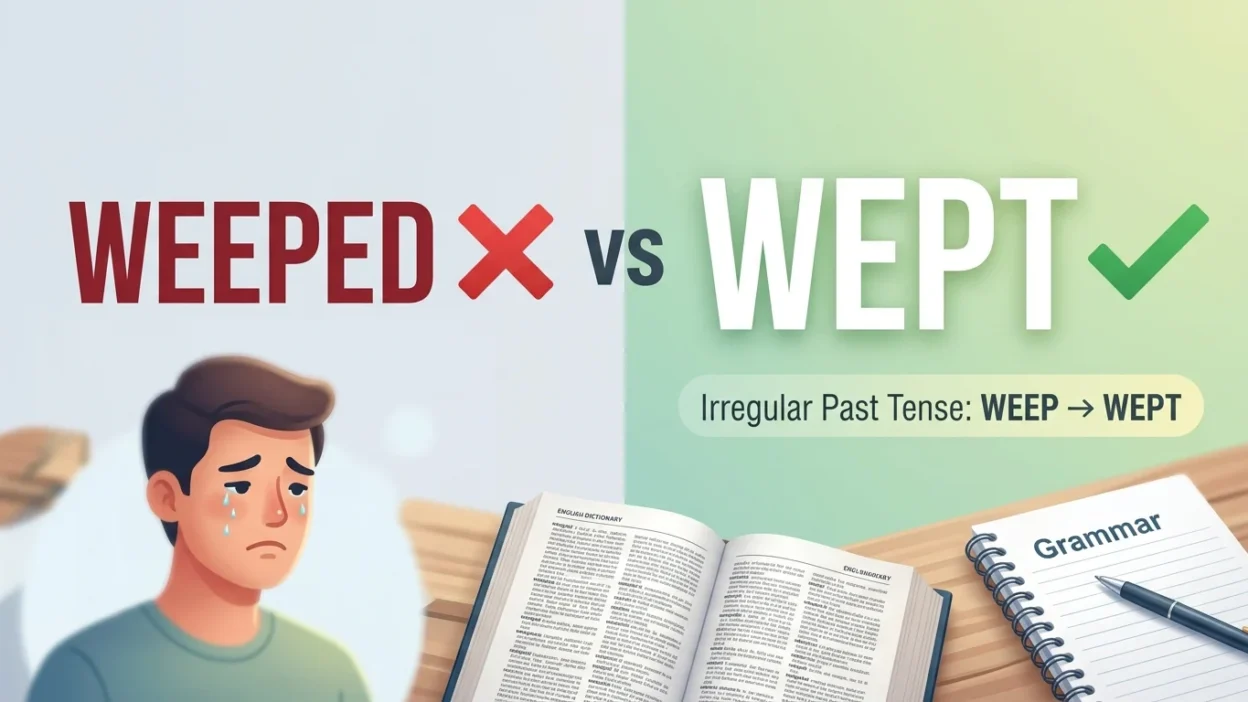
If you are wondering whether the correct past tense is weeped or wept, the standard English form is wept. Weeped is generally not used as the standard past tense of weep. The verb weep means to cry or shed tears, often because of sadness, grief, pain, or strong emotion.
The word wept is an irregular past tense and past participle of weep. Unlike regular verbs, it does not form its past tense by simply adding -ed. Understanding this change is useful for students, writers, and English learners because irregular verbs often have special past forms that must be learned individually.
Quick Answer
Wept is the correct past tense and past participle of weep. Use weep for the present, wept for the past, and wept after helping verbs such as had or have. Weeped is generally incorrect in standard modern English.
Why People Confuse It
The confusion comes from a common English pattern: many verbs form their past tense by adding -ed.
For example:
- walk → walked
- talk → talked
- laugh → laughed
- cry → cried
Because weep is a verb, learners may naturally assume that its past form should be weeped.
However, weep is an irregular verb. Its past forms do not follow the regular -ed pattern.
The correct forms are:
weep → wept → wept
This means:
- Present: weep
- Past: wept
- Past participle: wept
First Word: Weeped
Weeped is generally incorrect as the standard past tense of weep.
A learner may form weeped by applying the regular past-tense rule and adding -ed to weep. However, standard English uses the irregular form wept instead.
Incorrect:
- She weeped after hearing the news.
- He weeped quietly in his room.
- They had weeped for their lost friend.
Correct:
- She wept after hearing the news.
- He wept quietly in his room.
- They had wept for their lost friend.
For standard modern English writing, use wept rather than weeped.
Second Word: Wept
Wept is the correct past tense and past participle of weep.
To weep means to cry or shed tears. The word can describe quiet crying, deep sadness, grief, or another strong emotional response.
Examples:
- She wept when she heard the sad news.
- The child wept for several minutes.
- He wept with grief.
- They wept after saying goodbye.
As a past participle, wept can also be used with helping verbs:
- She had wept before anyone arrived.
- He has wept over the loss.
- They had wept together.
The basic verb forms are:
weep → wept → wept
Comparison Table
| Word | Correct? | Function | Example |
|---|---|---|---|
| weep | ✅ Yes | Present/base form | Some people weep when they are deeply sad. |
| wept | ✅ Yes | Past tense | She wept after hearing the news. |
| wept | ✅ Yes | Past participle | He had wept for hours. |
| weeped | ❌ No | Incorrect standard past form | She weeped after the news. |
When to Use Each
Use Weep for the Present
Use weep when describing something happening in the present or something that happens generally.
Examples:
- Some people weep when they are overwhelmed with emotion.
- She may weep when she hears the story.
- He does not usually weep in public.
Use Wept for the Past
Use wept when the crying happened in the past.
Examples:
- She wept after receiving the message.
- He wept throughout the ceremony.
- The child wept because he was frightened.
Use Wept as a Past Participle
Use wept with helping verbs such as have, has, and had.
Examples:
- She has wept many times over the years.
- He had wept before his family arrived.
- They have wept together during difficult times.
Do Not Use Weeped
In standard modern English, weeped is not the normal past form of weep.
Use:
weep → wept
not:
weep → weeped
12 Examples of Wept in Sentences
- She wept when she heard the heartbreaking news.
- The child wept after losing his favorite toy.
- He wept quietly in the corner.
- They wept when their friend moved away.
- The woman wept with relief after hearing that her family was safe.
- He wept throughout the emotional ceremony.
- She wept after reading the letter.
- The audience wept during the emotional scene.
- He had wept for hours before finally falling asleep.
- She has wept over the loss many times.
- The family wept together during the farewell.
- The character wept as he remembered his past.
Common Mistakes
Mistake 1: Adding -ed to Weep
The most common mistake is treating weep as a regular verb.
Incorrect:
weeped
Correct:
wept
Mistake 2: Using Weep for a Completed Past Action
If you are describing something that already happened, use wept.
Incorrect:
- Yesterday, she weep after hearing the news.
Correct:
- Yesterday, she wept after hearing the news.
Mistake 3: Confusing Wept With Weep
Remember that weep is the base form, while wept is used for the past.
- Today: She weeps easily.
- Yesterday: She wept after the news.
Mistake 4: Assuming Every Past Tense Ends in -ed
English contains many irregular verbs.
Examples:
- go → went
- see → saw
- take → took
- speak → spoke
- weep → wept
These verbs need to be learned as individual forms.
Memory Trick
A simple way to remember the correct form is:
WEep → WEPT
Think of the short change:
EEP → EPT
So:
weep → wept
You can also memorize the three main forms together:
weep – wept – wept
This is similar to:
- keep – kept – kept
- sleep – slept – slept
- sweep – swept – swept
These related patterns can make wept easier to remember.
American vs British English
There is no meaningful spelling difference between American and British English for weep and wept.
Both varieties use:
- weep — base form
- wept — past tense
- wept — past participle
For example:
- American English: She wept after hearing the news.
- British English: She wept after hearing the news.
The standard form remains wept in both varieties.
Similar Words
Several verbs are related to weep in meaning or spelling.
Cry
Cry is the most common everyday word for shedding tears.
Example: She cried after hearing the news.
Sob
Sob means to cry with short, uncontrolled breaths.
Example: The child sobbed after the accident.
Tear Up
Tear up is an informal expression meaning to begin to have tears in your eyes.
Example: He started to tear up during the speech.
Mourn
Mourn means to express deep sadness, especially after a death or major loss.
Example: The family mourned their loved one.
Keep → Kept
This verb has a similar spelling change:
keep → kept
Sleep → Slept
Another useful spelling comparison is:
sleep → slept
Sweep → Swept
This follows a similar pattern:
sweep → swept
These examples can help you remember that weep → wept is an irregular verb pattern.
Final Verdict
The correct form is wept.
Weeped is generally incorrect as the standard past tense of weep.
Remember the three forms:
weep → wept → wept
Use weep as the base form and wept for both the simple past and past participle.
FAQs
Is weeped a correct word?
Weeped is generally not the standard past tense of weep. In standard modern English, use wept.
Is it weeped or wept?
The correct form is wept. For example: She wept after hearing the news.
What is the past tense of weep?
The past tense of weep is wept.
What is the past participle of weep?
The past participle is also wept. For example: She had wept before her family arrived.
Why is wept used instead of weeped?
Weep is an irregular verb, so it does not form its past tense by simply adding -ed. Its standard past form is wept.
What are the three forms of weep?
The three main forms are:
weep – wept – wept
Is wept used in American and British English?
Yes. Wept is the standard past form in both American and British English.
What is the difference between weep and cry?
Both can mean shedding tears, but cry is much more common in everyday English. Weep can sound more literary, formal, or emotionally expressive depending on the context.
Remember This
The easiest rule is:
Weep → Wept
Not:
Weep → Weeped ❌
But:
Weep → Wept ✅
Remember all three forms:
weep – wept – wept
If the action happened in the past, choose wept.
Conclusion
The difference between weeped and wept comes down to an irregular verb form. Wept is the correct standard past tense and past participle of weep, while weeped is generally not used as the standard form. The verb means to cry or shed tears and can describe sadness, grief, relief, or another strong emotional response.
To use the word correctly, remember the simple pattern weep → wept → wept. Just as English has other irregular verbs such as keep → kept and sleep → slept, weep changes its form rather than taking the regular -ed ending. Using wept will make your writing grammatically accurate and natural.

Gabriel John is a language enthusiast and grammar writer at Synolexes. He creates clear, practical content on English grammar, vocabulary, and writing, helping learners improve communication skills with confidence.