Have you ever used the word complex repeatedly in your writing? While complex is a useful English word, using it too often can make your content feel repetitive.
Learning different synonyms for complex helps you describe ideas, problems, systems, emotions, and situations with greater accuracy and variety.
If you’re a student writing essays, an ESL learner expanding your vocabulary, a writer creating engaging stories, or a content creator producing high-quality articles, understanding alternatives to complex can make your writing more natural and expressive.
Each synonym has its own meaning and works best in different contexts.
In this guide, you’ll discover 30 useful synonyms for complex, along with simple meanings, example sentences, and the best situations to use each one. By the end, you’ll know exactly which word fits your writing.
What Does “Complex” Mean?
Simple Meaning of Complex
The word complex describes something that has many parts, details, or ideas that make it difficult to understand, explain, or solve. It can refer to problems, emotions, systems, designs, or situations that require careful thought.
When Do We Use the Word “Complex”?
We use complex to describe difficult tasks, advanced ideas, detailed systems, challenging situations, scientific topics, and complicated relationships.
Examples:
- The math problem is complex.
- She explained the complex process clearly.
- Human emotions are often complex.
Although complex is a common word, using different synonyms can improve your vocabulary and make your writing more engaging.
30 Synonyms for Complex
Complete List of Synonyms
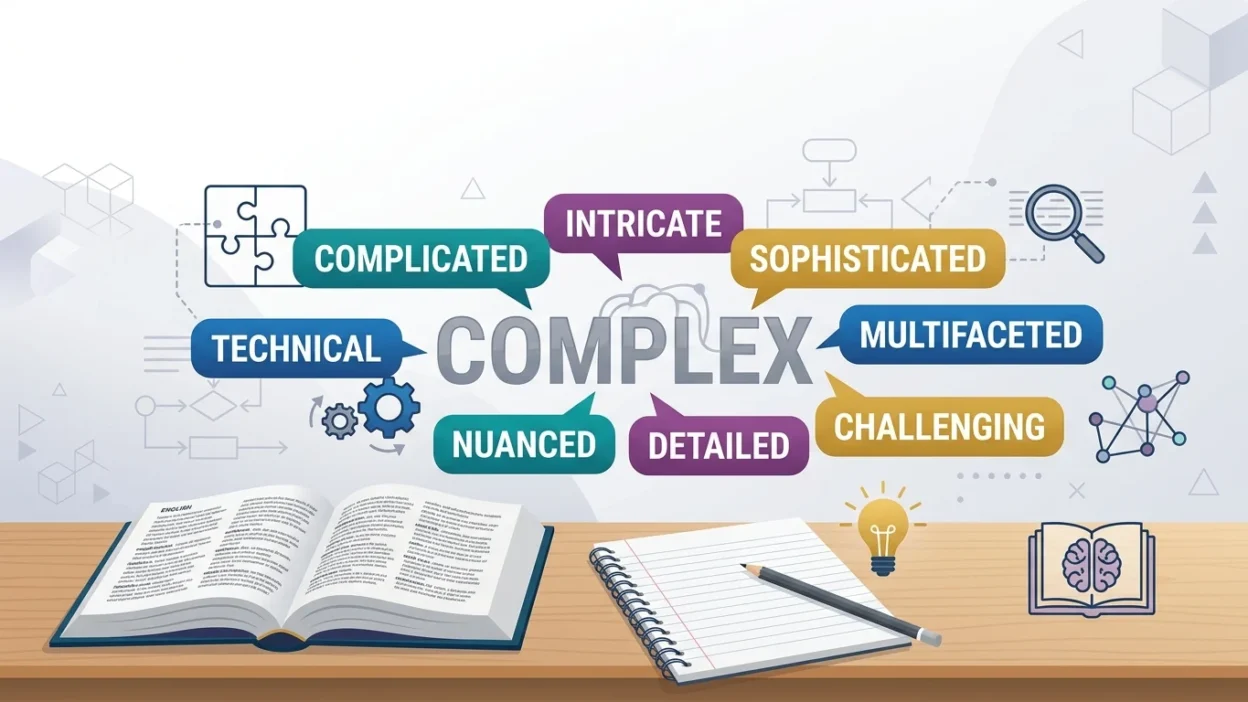
Here are 30 useful synonyms for complex:
- Complicated
- Intricate
- Sophisticated
- Detailed
- Advanced
- Difficult
- Challenging
- Multifaceted
- Elaborate
- Confusing
- Knotty
- Involved
- Technical
- Layered
- Puzzling
- Perplexing
- Convoluted
- Dense
- Comprehensive
- Interconnected
- Nuanced
- Deep
- Tricky
- Demanding
- Compounded
- Tangled
- Byzantine
- Multifarious
- Labyrinthine
- Hard
Synonyms for Complex with Meanings, Examples, and Usage
1. Complicated
Meaning: Difficult because it has many parts or steps.
Example Sentence:
The instructions looked complicated at first.
Best Usage Context:
Perfect for education, technology, business, and everyday conversations.
2. Intricate
Meaning: Having many small and detailed parts.
Example Sentence:
The artist created an intricate pattern.
Best Usage Context:
Ideal for art, architecture, design, and craftsmanship.
3. Sophisticated
Meaning: Highly developed or advanced.
Example Sentence:
The company uses sophisticated software.
Best Usage Context:
Best for technology, science, engineering, and business.
4. Detailed
Meaning: Including many facts or pieces of information.
Example Sentence:
She wrote a detailed report about the project.
Best Usage Context:
Suitable for reports, education, research, and professional writing.
5. Advanced
Meaning: More difficult or developed than basic levels.
Example Sentence:
He enrolled in an advanced English course.
Best Usage Context:
Perfect for education, science, technology, and training.
6. Difficult
Meaning: Hard to understand or complete.
Example Sentence:
It was a difficult decision to make.
Best Usage Context:
Useful for everyday conversation, education, and work.
7. Challenging
Meaning: Requiring effort, skill, or determination.
Example Sentence:
Learning a new language can be challenging.
Best Usage Context:
Best for education, careers, sports, and self-improvement.
8. Multifaceted
Meaning: Having many different aspects or features.
Example Sentence:
She has a multifaceted personality.
Best Usage Context:
Ideal for business, psychology, leadership, and literature.
9. Elaborate
Meaning: Carefully planned with many details.
Example Sentence:
They prepared an elaborate celebration.
Best Usage Context:
Perfect for events, design, writing, and architecture.
10. Confusing
Meaning: Difficult to understand because it is unclear.
Example Sentence:
The map was confusing for first-time visitors.
Best Usage Context:
Suitable for instructions, education, technology, and communication.
11. Knotty
Meaning: Very difficult to solve or understand.
Example Sentence:
The lawyer faced a knotty legal issue.
Best Usage Context:
Best for law, philosophy, debates, and problem-solving.
12. Involved
Meaning: Containing many connected parts or steps.
Example Sentence:
The application process is quite involved.
Best Usage Context:
Ideal for business, education, and administration.
13. Technical
Meaning: Related to specialized knowledge or skills.
Example Sentence:
The manual contains technical information.
Best Usage Context:
Perfect for engineering, IT, science, and professional writing.
14. Layered
Meaning: Having several levels of meaning or structure.
Example Sentence:
The novel has a layered storyline.
Best Usage Context:
Best for literature, films, psychology, and storytelling.
15. Puzzling
Meaning: Difficult to understand or explain.
Example Sentence:
His sudden decision was puzzling.
Best Usage Context:
Useful for mysteries, discussions, journalism, and everyday writing.
16. Perplexing
Meaning: Very confusing and difficult to understand.
Example Sentence:
The detective faced a perplexing mystery.
Best Usage Context:
Perfect for mysteries, academic discussions, journalism, and problem-solving.
17. Convoluted
Meaning: Extremely complicated with many confusing details.
Example Sentence:
The contract contained convoluted legal language.
Best Usage Context:
Best for legal writing, business documents, and technical explanations.
18. Dense
Meaning: Difficult to understand because of a lot of information.
Example Sentence:
The textbook is dense but informative.
Best Usage Context:
Suitable for academic writing, research, and scientific materials.
19. Comprehensive
Meaning: Covering many details or aspects completely.
Example Sentence:
The report provides a comprehensive analysis.
Best Usage Context:
Ideal for education, business, research, and professional reports.
20. Interconnected
Meaning: Connected with many related parts.
Example Sentence:
The departments are interconnected through shared projects.
Best Usage Context:
Perfect for business, science, technology, and environmental topics.
21. Nuanced
Meaning: Having subtle differences or fine details.
Example Sentence:
The speaker gave a nuanced explanation of the issue.
Best Usage Context:
Best for essays, literature, politics, and critical thinking.
22. Deep
Meaning: Requiring careful thought or understanding.
Example Sentence:
The documentary explores deep social issues.
Best Usage Context:
Suitable for philosophy, education, psychology, and discussions.
23. Tricky
Meaning: Difficult because it requires careful attention.
Example Sentence:
This grammar rule can be tricky for beginners.
Best Usage Context:
Perfect for education, sports, games, and everyday conversations.
24. Demanding
Meaning: Requiring a lot of effort, time, or skill.
Example Sentence:
The job is demanding but rewarding.
Best Usage Context:
Best for careers, education, fitness, and personal development.
25. Compounded
Meaning: Made more difficult by additional problems.
Example Sentence:
The delays were compounded by bad weather.
Best Usage Context:
Suitable for business, healthcare, finance, and news writing.
26. Tangled
Meaning: Twisted together in a confusing way.
Example Sentence:
The investigation became tangled with conflicting evidence.
Best Usage Context:
Ideal for storytelling, relationships, law, and journalism.
27. Byzantine
Meaning: Extremely complicated with many rules or procedures.
Example Sentence:
The organization had a Byzantine approval process.
Best Usage Context:
Best for politics, law, government, and formal writing.
28. Multifarious
Meaning: Having many different parts or forms.
Example Sentence:
The museum displays multifarious cultural artifacts.
Best Usage Context:
Suitable for academic writing, literature, and formal essays.
29. Labyrinthine
Meaning: So complicated that it feels like a maze.
Example Sentence:
The city’s labyrinthine streets confused visitors.
Best Usage Context:
Perfect for architecture, travel writing, mysteries, and literature.
30. Hard
Meaning: Difficult to understand, do, or solve.
Example Sentence:
Learning a new programming language can be hard.
Best Usage Context:
Ideal for everyday conversations, education, and informal writing.
Comparison Guide: When to Use Different Synonyms
Choosing the Best Word for the Situation
| Synonym | Best Used For | Tone |
|---|---|---|
| Complicated | Everyday writing | Neutral |
| Intricate | Art, design | Professional |
| Sophisticated | Technology, science | Formal |
| Detailed | Reports, education | Professional |
| Challenging | Learning, careers | Positive |
| Multifaceted | Personalities, business | Formal |
| Elaborate | Events, architecture | Descriptive |
| Technical | Engineering, IT | Professional |
| Nuanced | Essays, discussions | Academic |
| Comprehensive | Reports, research | Formal |
| Tricky | Daily conversation | Casual |
| Dense | Academic texts | Formal |
| Tangled | Stories, relationships | Descriptive |
| Byzantine | Law, government | Advanced |
| Labyrinthine | Literature, travel | Literary |
How to Choose the Right Synonym
For Academic Writing
Use formal and precise words.
Good choices include:
- Sophisticated
- Comprehensive
- Nuanced
- Detailed
- Technical
- Dense
For Creative Writing
Choose descriptive words that create vivid images.
Try these words:
- Intricate
- Layered
- Labyrinthine
- Tangled
- Puzzling
- Elaborate
For Everyday Conversation
Use simple, natural alternatives.
Consider using:
- Complicated
- Difficult
- Challenging
- Hard
- Tricky
- Confusing
For Business and Professional Writing
Professional communication often benefits from precise language.
Useful options include:
- Comprehensive
- Sophisticated
- Technical
- Interconnected
- Involved
- Demanding
For Problem-Solving and Critical Thinking
These words describe issues that require careful analysis.
Excellent choices include:
- Perplexing
- Knotty
- Nuanced
- Compounded
- Challenging
- Multifaceted
Common Mistakes to Avoid
Don’t Use Every Synonym Interchangeably
Although these words all relate to complexity, they have different meanings. For example, intricate emphasizes detailed design, while challenging highlights the effort needed to complete something.
Match the Tone
Formal writing sounds stronger with words like comprehensive, nuanced, or sophisticated, while casual conversations usually work better with hard, tricky, or complicated.
Consider the Context
Choose the synonym that best fits the situation. A machine can be technical, a novel can be layered, and a legal process can be Byzantine.
FAQs
What is the best synonym for “complex”?
Some of the best synonyms are complicated, intricate, sophisticated, challenging, and multifaceted. The best choice depends on the context.
Which synonym is best for essays?
For academic writing, nuanced, comprehensive, technical, detailed, and sophisticated are excellent choices because they sound formal and precise.
Is “complicated” the same as “complex”?
They are very similar. However, complex often refers to something with many connected parts, while complicated usually emphasizes that something is difficult to understand or complete.
Can I use “intricate” instead of “complex”?
Yes. Intricate is a great synonym when describing detailed patterns, artwork, designs, or systems with many connected parts.
Conclusion
Learning different synonyms for complex helps you describe difficult ideas, systems, and situations with greater accuracy.
While complex is a useful everyday word, choosing a more specific synonym makes your writing clearer, richer, and more engaging.
If you’re writing an essay, explaining a scientific concept, describing a challenging problem, or improving your English vocabulary, words like intricate, sophisticated, nuanced, challenging, comprehensive, and multifaceted can strengthen your communication.
Practice using these alternatives in different contexts to become a more confident English writer and speaker.