
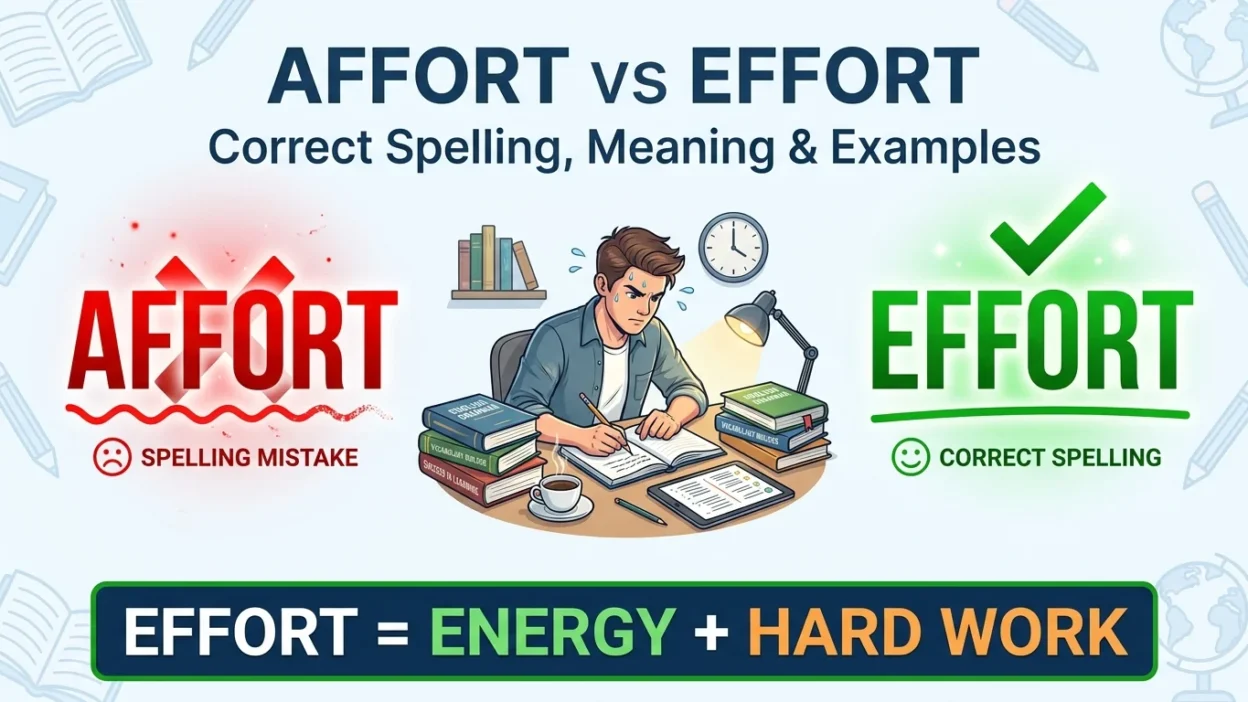
When comparing affort vs effort, the correct spelling is effort. Affort is a common spelling mistake and is not a standard English word for describing the energy, work, or determination needed to do something. Effort refers to the physical or mental energy you use to complete a task, solve a problem, or achieve a goal.
Understanding the difference between these spellings can help students, English learners, and writers communicate more clearly. Although affort and effort may sound similar when spoken quickly, only effort is correct in standard English. You can use it in everyday conversations, school assignments, professional emails, and formal writing. In this guide, you will learn the meaning of effort, see how to use it correctly in sentences, and discover simple ways to remember its spelling.
Quick Answer: Affort or Effort?
Effort is the correct spelling in standard English. It means the physical or mental energy someone uses to accomplish something. Affort is a misspelling of effort and should not be used when describing hard work, dedication, or an attempt to achieve a goal. Remember the correct spelling: E-F-F-O-R-T.
Why Do People Confuse Affort and Effort?
People confuse affort and effort because the words look and sound somewhat similar. When speaking quickly, some people may not clearly distinguish the initial vowel sound, which can lead to spelling mistakes.
Another reason is that English spelling does not always match pronunciation perfectly. Writers may spell a word according to how they think it sounds instead of remembering its standard form.
The easiest way to avoid this mistake is to remember that the correct word begins with E and contains two Fs.
- Incorrect: affort
- Correct: effort
What Does Affort Mean?
Affort is not a standard English spelling of the word effort. It is generally a spelling mistake made when someone intends to refer to hard work, energy, or dedication.
For example:
- Incorrect: She made a great affort to improve her English.
- Correct: She made a great effort to improve her English.
In standard writing, always use effort when talking about trying hard or working toward a goal.
What Does Effort Mean?
Effort is a noun that means the physical or mental energy someone uses to do something. It can describe hard work, an attempt, or the determination needed to complete a task.
Effort can be used in many situations, including studying, exercising, working, learning a skill, and helping others.
Examples of Effort in Sentences
- She put a lot of effort into her studies.
- Learning a new language requires effort and patience.
- His effort helped the team win the match.
- Thank you for your effort and dedication.
- Every small effort can bring you closer to your goal.
Effort can refer to a single attempt or the energy someone invests over time.
Affort vs Effort: Comparison Table
| Feature | Affort | Effort |
|---|---|---|
| Spelling status | Incorrect for the intended meaning | Correct |
| Standard English word for hard work | No | Yes |
| Part of speech | Not standard in this usage | Noun |
| Meaning | Usually a misspelling of effort | Energy or work used to achieve something |
| Suitable for formal writing | No | Yes |
| Example | She made an affort. | She made an effort. |
The main difference is simple: effort is the correct word, while affort is a spelling mistake when used with this intended meaning.
When to Use Each Word
When Should You Use Affort?
You should not use affort when you mean hard work, energy, or an attempt to achieve something. In standard English, replace it with effort.
Incorrect: I made an affort to finish my homework.
Correct: I made an effort to finish my homework.
When Should You Use Effort?
Use effort whenever you want to describe the energy, work, or determination involved in doing something.
1. For studying and learning
Example: She put extra effort into learning English grammar.
2. For work and professional tasks
Example: The project required considerable effort from the entire team.
3. For sports and physical activities
Example: The players gave their best effort during the game.
4. For personal goals
Example: Success often comes from consistent effort and patience.
5. For relationships and helping others
Example: Maintaining a strong friendship takes effort from both people.
15 Examples of Affort vs Effort
The following examples show how to correct affort and use effort naturally in sentences.
| Incorrect Sentence | Correct Sentence |
|---|---|
| I made an affort to study harder. | I made an effort to study harder. |
| She puts a lot of affort into her work. | She puts a lot of effort into her work. |
| His affort was appreciated by everyone. | His effort was appreciated by everyone. |
| Learning English takes affort. | Learning English takes effort. |
| They made a great affort to help us. | They made a great effort to help us. |
| Your affort will make a difference. | Your effort will make a difference. |
| He gave his best affort in the competition. | He gave his best effort in the competition. |
| Success requires time and affort. | Success requires time and effort. |
| I appreciate your affort and support. | I appreciate your effort and support. |
| The team made a strong affort to finish on time. | The team made a strong effort to finish on time. |
| She showed great affort during training. | She showed great effort during training. |
| Every affort counts when learning a skill. | Every effort counts when learning a skill. |
| He put extra affort into his presentation. | He put extra effort into his presentation. |
| Their affort helped solve the problem. | Their effort helped solve the problem. |
| Consistent affort leads to improvement. | Consistent effort leads to improvement. |
Common Mistakes to Avoid
Here are some common mistakes involving effort and related expressions.
1. Writing Affort Instead of Effort
Incorrect: I appreciate your affort.
Correct: I appreciate your effort.
Remember that effort begins with E, not A.
2. Using the Wrong Article
Effort is often used as an uncountable noun when referring to work or energy in general. However, it can also be countable when referring to a particular attempt.
- She put effort into her studies.
- He made an effort to apologize.
- They made several efforts to solve the issue.
Use an effort when referring to one particular attempt.
3. Confusing Effort With Result
Effort describes the work or energy someone invests. It does not always mean the person will succeed.
Example: Despite her effort, she did not pass the exam.
This sentence shows that someone can work hard without achieving the desired result.
4. Forgetting Common Expressions
These expressions are commonly used with effort:
- Make an effort
- Put in effort
- Give your best effort
- Require effort
- Appreciate someone’s effort
- Make every effort
Learning these phrases will help you use the word naturally.
Easy Memory Trick to Remember Effort
Use this simple memory trick:
Effort begins with E, and effort means energy.
Both words begin with the letter E, which makes the connection easy to remember.
You can also practice this sentence:
I make an effort to improve every day.
Write it a few times and focus on the spelling E-F-F-O-R-T.
American vs British English: Affort vs Effort
There is no spelling difference between American and British English for this word. Both varieties use effort.
| English Variety | Correct Spelling | Incorrect Spelling |
|---|---|---|
| American English | effort | affort |
| British English | effort | affort |
| Australian English | effort | affort |
| Canadian English | effort | affort |
Regardless of where you are writing or speaking English, use effort when you mean hard work, energy, or an attempt.
Similar Words to Effort
Several English words have meanings related to effort, but they are not always interchangeable.
| Word | Meaning | Example |
|---|---|---|
| Attempt | An act of trying to do something | She made an attempt to solve the puzzle. |
| Endeavor | A serious or determined effort | Learning a language is a worthwhile endeavor. |
| Hard work | Sustained work requiring energy | Hard work helped him improve. |
| Exertion | Physical or mental energy used | The climb required considerable exertion. |
| Dedication | Commitment to a task or goal | Her dedication impressed the teacher. |
| Persistence | Continuing despite difficulty | Persistence helped him overcome challenges. |
| Struggle | Difficult effort to do something | He struggled to understand the lesson. |
These words can help you express different kinds of effort more precisely.
Final Verdict: Affort or Effort?
The correct spelling is effort. Affort is a common misspelling when someone intends to describe hard work, energy, or an attempt to accomplish something.
Use effort in sentences such as I made an effort to improve and Success requires time and effort. Remember that effort begins with E and contains two Fs. This simple spelling rule will help you avoid the mistake in schoolwork, professional communication, and everyday writing.
FAQs
1. Is affort or effort correct?
Effort is correct. Affort is a misspelling when used to mean hard work, energy, or an attempt to achieve something.
2. What does effort mean in simple English?
Effort means the energy, work, or determination you use to do something. For example, studying every day requires effort.
3. Is affort a real English word?
Affort is not the standard English spelling of the word meaning hard work or an attempt. In this context, use effort.
4. How do you spell effort correctly?
The correct spelling is E-F-F-O-R-T: effort. It begins with E and contains two Fs.
5. What is the plural of effort?
The plural is efforts. For example, She made several efforts to solve the problem.
6. What is another word for effort?
Depending on the context, alternatives include attempt, endeavor, hard work, exertion, dedication, and persistence.
7. Is effort the same in American and British English?
Yes. Effort is spelled the same way in both American and British English.
8. How do you use effort in a sentence?
You can write: He made an effort to finish his homework before dinner. Here, effort means an attempt that requires work or energy.
Remember This
- Effort = correct spelling.
- Affort = incorrect spelling for the intended meaning.
- Effort means work, energy, or an attempt.
- The plural of effort is efforts.
- American and British English both use effort.
Conclusion
Understanding affort vs effort is simple once you remember the correct spelling. Effort is the standard English word for the energy, work, and determination needed to accomplish something. Affort is a common spelling mistake and should be corrected to effort in standard writing.
Whether you are studying for an exam, completing a work project, learning a new skill, or pursuing a personal goal, effort is the word you need. Remember the spelling E-F-F-O-R-T, practice it in everyday sentences, and use it confidently in your writing.

Gabriel John is a language enthusiast and grammar writer at Synolexes. He creates clear, practical content on English grammar, vocabulary, and writing, helping learners improve communication skills with confidence.


