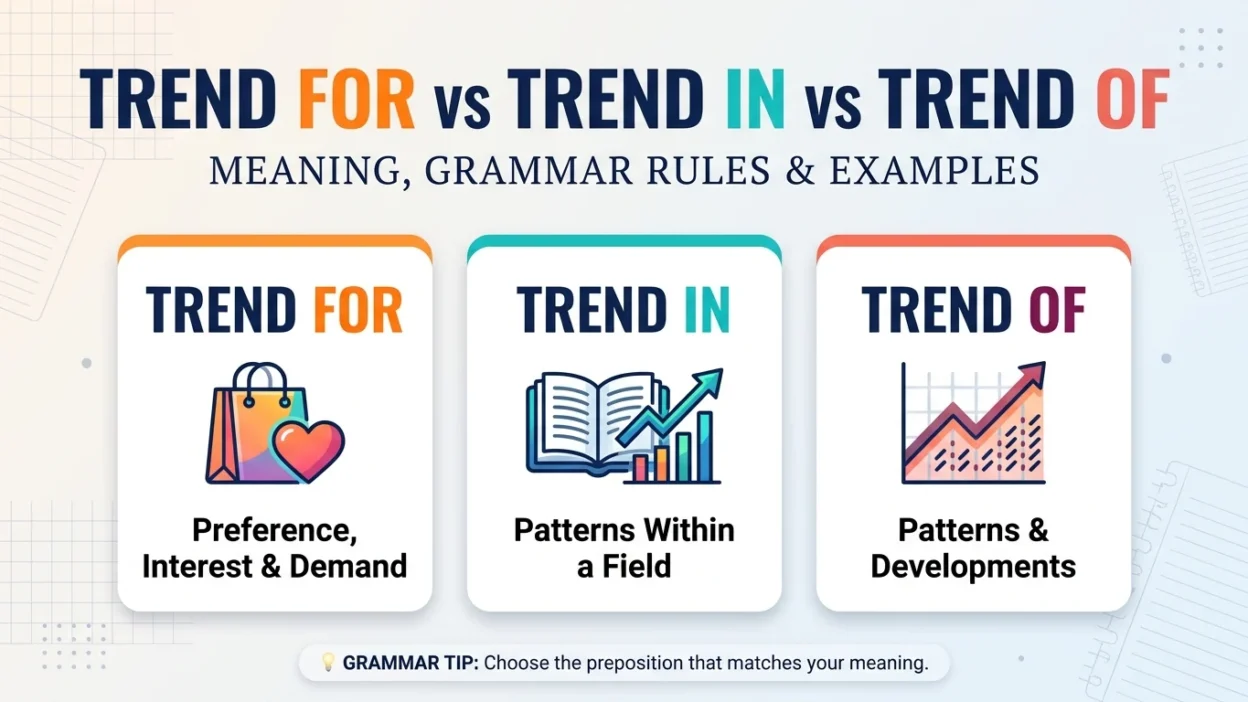
The phrases trend for, trend in, and trend of may look similar, but they are used in different ways. Choosing the right preposition depends on what you want to describe, such as a growing interest in something, a change within a particular field, or a general pattern of behavior.
The most common expression is trend in, which refers to a developing pattern within a particular area, subject, or activity. For example, a trend in fashion describes changing styles, while a trend in technology refers to developments in the technology industry. Trend for can describe growing demand or popularity for something, as in a trend for sustainable clothing. Trend of is often used before a noun or gerund to describe a general pattern, as in a trend of increasing prices, although other constructions may sound more natural depending on the sentence.
Understanding these differences will help you write more naturally, choose the correct preposition, and avoid common grammar mistakes in academic writing, business communication, and everyday English.
Quick Answer
Use trend in to describe a pattern within a subject or field, such as a trend in education. Use trend for when describing a growing preference or demand for something, such as a trend for healthier food. Use trend of to describe a general pattern or repeated development, such as a trend of rising costs.
Why Do People Confuse These Expressions?
People often confuse these expressions because the noun trend can be followed by several prepositions. Each preposition adds a slightly different meaning, and the best choice depends on the sentence structure.
Here are the main reasons for the confusion:
- Similar meanings: All three expressions can describe changes, preferences, or patterns.
- Overlapping usage: Some sentences can use different prepositions while emphasizing slightly different ideas.
- Direct translation: Learners may translate expressions from their first language and choose a preposition that sounds unnatural in English.
- Different grammatical structures: The noun following trend can refer to a field, an object, a preference, or an ongoing action.
The easiest approach is to identify what follows trend and what you want the sentence to communicate.
1. Trend In: Meaning and Usage
Trend in is generally used to identify the subject, field, industry, or area in which a pattern or change is happening.
It is one of the most common and versatile constructions with trend.
When to Use Trend In
Use trend in when talking about:
- A particular industry or field
- Changes in behavior or society
- Developments in technology
- Patterns in statistics or research
- Changes within a subject or activity
Examples of Trend In
- There is a growing trend in online education.
- The latest trend in fashion favors comfortable clothing.
- Researchers noticed a trend in consumer behavior.
- A new trend in technology is changing how people work.
- The report identifies a trend in rising housing costs.
- There is a positive trend in student performance.
- The company is studying trends in customer preferences.
- A new trend in interior design uses natural materials.
In these examples, in introduces the area where the trend exists.
2. Trend For: Meaning and Usage
Trend for can describe a growing preference, interest, demand, or movement toward a particular thing. It often appears when discussing products, lifestyles, styles, or consumer choices.
However, trend for is less universally natural than trend in. In many contexts, a trend toward, a growing preference for, or demand for may communicate the idea more clearly.
When to Use Trend For
Use trend for when the sentence emphasizes:
- A preference for a particular product or style
- Growing interest in a particular activity
- Demand for a particular service
- A movement toward a certain choice or practice
Examples of Trend For
- There is a growing trend for sustainable clothing.
- The trend for healthier meals is gaining attention.
- A trend for minimalist furniture has influenced home design.
- The trend for remote working has changed many workplaces.
- There is increasing demand for reusable packaging.
- A growing preference for natural ingredients is influencing product design.
- The trend toward electric vehicles continues to attract attention.
- Many businesses are responding to the trend for personalized services.
Notice that some examples use alternatives such as demand for and trend toward. These are often more natural choices when the meaning needs to be precise.
3. Trend Of: Meaning and Usage
Trend of can introduce a pattern, characteristic, or continuing development. It is particularly useful when followed by an activity ending in -ing or by a phrase describing a repeated change.
For example, a trend of increasing prices describes a pattern in which prices continue to rise.
However, trend of is not interchangeable with trend in in every sentence. Depending on the meaning, expressions such as a trend toward, a pattern of, or an increase in may sound more natural.
When to Use Trend Of
Use trend of when describing:
- A repeated or continuing action
- A pattern of change
- A developing tendency
- A general characteristic that appears repeatedly
Examples of Trend Of
- The trend of rising prices has affected many families.
- We noticed a trend of increasing online sales.
- The trend of working longer hours concerns many employees.
- There is a trend of people choosing simpler lifestyles.
- The report highlights a trend of declining participation.
- The trend of using digital payments has grown in many markets.
- Analysts observed a trend of customers switching brands.
- The trend of increasing temperatures requires further study.
Some of these sentences can also be rewritten with toward, in, or a more specific noun phrase. The best option depends on the intended meaning and the style of writing.
Comparison Table: Trend For vs Trend In vs Trend Of
| Expression | Main use | Example |
|---|---|---|
| Trend in | Identifies the field or area where a pattern occurs | A trend in education |
| Trend for | Describes a preference, interest, or demand | A trend for sustainable products |
| Trend of | Describes a pattern or continuing development | A trend of rising prices |
| Trend toward | Emphasizes movement or change in a particular direction | A trend toward healthier eating |
Important: These expressions sometimes overlap. Choose the preposition that best expresses the relationship between the trend and the following words.
When Should You Use Each Expression?
The right expression depends on your intended meaning.
Use Trend In for a Field or Subject
Choose trend in when the trend happens within a particular area.
- A trend in medicine
- A trend in education
- A trend in social media
- A trend in consumer spending
Example: The study examines a trend in online shopping.
Use Trend For for a Preference or Demand
Choose trend for when describing interest in or preference for something, while remembering that alternatives may sound more natural.
- A trend for eco-friendly packaging
- A trend for casual clothing
- A trend for personalized products
Example: There is a growing preference for eco-friendly packaging.
Use Trend Of for a Pattern or Development
Choose trend of when introducing an ongoing action or a pattern of change, especially with an -ing phrase.
- A trend of increasing costs
- A trend of declining attendance
- A trend of changing consumer habits
Example: The company noticed a trend of increasing customer complaints.
Use Trend Toward for a Direction of Change
Trend toward is often the clearest choice when something is moving in a particular direction.
Example: There is a growing trend toward flexible working arrangements.
15 Example Sentences Using Trend For, In, and Of
Here are practical examples showing how the expressions work in everyday and formal English.
- Trend in: The latest trend in fashion emphasizes comfort.
- Trend in: Researchers identified a trend in consumer spending.
- Trend in: There is a growing trend in digital learning.
- Trend in: The report describes a trend in workplace communication.
- Trend in: We noticed a trend in student attendance.
- Trend for: There is a growing trend for sustainable fashion.
- Trend for: The trend for healthier snacks is influencing supermarkets.
- Trend for: A trend for simple home decorations has become noticeable.
- Trend for: The business responded to the trend for customized products.
- Trend of: The trend of rising rents has affected local residents.
- Trend of: Analysts observed a trend of increasing online purchases.
- Trend of: The trend of declining sales worried the company.
- Trend of: The report discusses a trend of changing work habits.
- Trend toward: There is a trend toward using renewable energy.
- Trend toward: Many companies are following a trend toward more flexible schedules.
These examples show that in usually identifies an area, for can express a preference, and of can introduce a pattern. Toward is useful when the sentence emphasizes direction.
Common Mistakes to Avoid
Even advanced English learners can choose an awkward preposition after trend. Here are some common problems.
Mistake 1: Using Trend In When You Mean Direction
Less precise: There is a trend in healthier eating.
Clearer: There is a trend toward healthier eating.
Use toward when you want to emphasize movement in a particular direction.
Mistake 2: Assuming Trend For Is Always the Best Choice
Less natural in many contexts: There is a trend for people buying electric cars.
Clearer: There is a trend toward people buying electric cars.
Also natural: There is growing demand for electric cars.
The phrase trend for does not work equally well with every grammatical structure.
Mistake 3: Using Trend Of Without Checking the Sentence
Possible: We observed a trend of prices increasing.
Often clearer: We observed a trend of increasing prices.
Also natural: We observed an increase in prices.
Choose the construction that makes the sentence easiest to understand.
Mistake 4: Treating All Three Expressions as Interchangeable
The following phrases do not communicate exactly the same relationship:
- A trend in technology describes a development within technology.
- A trend for new technology suggests growing interest in or preference for new technology.
- A trend of increasing technology use describes a continuing pattern of use.
Mistake 5: Forgetting Natural Alternatives
Sometimes another phrase is more suitable than any of the three expressions.
For example:
- Demand for a product
- A preference for a style
- A pattern of behavior
- A trend toward a lifestyle
- An increase in sales
Clear English is more important than forcing a particular preposition into every sentence.
Memory Trick: How to Remember the Difference
Use this simple guide to remember the main distinction.
- IN = Area: Think about where the trend happens.
- FOR = Preference: Think about what people want or favor.
- OF = Pattern: Think about what is happening repeatedly or changing.
- TOWARD = Direction: Think about where the change is going.
For example:
- A trend in education
- A trend for sustainable products
- A trend of rising prices
- A trend toward renewable energy
Remember that these are useful guidelines, not absolute rules for every sentence.
American vs British English
The basic meanings of trend in, trend for, and trend of are generally the same in American and British English.
| Expression | American English | British English |
|---|---|---|
| Trend in fashion | Common | Common |
| Trend for healthier food | Understandable; alternatives may be preferred | Understandable; alternatives may be preferred |
| Trend of rising prices | Understandable | Understandable |
| Trend toward change | Common | Common |
| Trend towards change | Also used | Common |
The main spelling difference is toward versus towards. Both are correct. Toward is especially common in American English, while towards is particularly common in British English, although both forms appear in each variety.
Similar Words and Expressions
Several expressions can replace trend or make its meaning more precise.
1. Pattern
A repeated or recognizable way in which something happens.
Example: The researchers identified a pattern in customer behavior.
2. Tendency
A likelihood or inclination to behave in a certain way.
Example: There is a tendency for prices to rise during periods of high demand.
3. Movement
A broader shift in public attitudes, behavior, or social activity.
Example: The movement toward sustainable living is gaining attention.
4. Preference
A choice or liking for one thing over another.
Example: There is a growing preference for locally produced food.
5. Development
A change or new stage in a process or situation.
Example: This development in technology has changed the industry.
6. Shift
A noticeable change in direction, focus, or behavior.
Example: The company noticed a shift in customer preferences.
7. Demand
The desire or need for a product or service, especially when people are willing to obtain it.
Example: Demand for electric vehicles has increased.
Final Verdict: Trend For vs Trend In vs Trend Of
The best preposition depends on what you want to say.
- Choose trend in to identify the area where a pattern occurs.
- Choose trend for when describing a preference or interest, but check whether preference for or demand for sounds more natural.
- Choose trend of when describing a continuing pattern or development, particularly before an -ing phrase.
- Choose trend toward when emphasizing movement in a particular direction.
If you are unsure, start by identifying the meaning you want to express. The most natural sentence may use a different preposition or a related expression.
FAQs
1. Is trend in or trend of correct?
Both can be correct, but they serve different purposes. Trend in usually identifies a field or subject, as in a trend in education. Trend of can describe a continuing pattern, as in a trend of rising prices.
2. Should I use trend for or trend in?
Use trend in for a pattern within a subject or field. Use trend for when describing a preference or growing interest, although preference for and demand for may sound more natural in many sentences.
3. Is trend for grammatically correct?
Yes, trend for can be grammatically correct. Its naturalness depends on the sentence. For example, a trend for sustainable clothing is understandable, while a growing preference for sustainable clothing may be clearer.
4. Can I say a trend of increasing prices?
Yes. A trend of increasing prices describes a pattern in which prices rise over time. You could also say a trend in prices or a pattern of rising prices, depending on what you want to emphasize.
5. What preposition follows trend?
The noun trend can be followed by several prepositions, including in, for, of, and toward. The correct choice depends on the intended meaning and grammatical structure.
6. Is trend towards correct?
Yes. Trend towards is correct and emphasizes movement or change in a particular direction. Trend toward is also correct, with the latter especially common in American English.
7. What is the difference between trend in and trend toward?
Trend in identifies the area where a pattern occurs, such as a trend in education. Trend toward describes a movement in a particular direction, such as a trend toward online learning.
Remember This
- Trend in: A pattern within an area or subject.
- Trend for: A preference or interest, depending on context.
- Trend of: A continuing pattern or development.
- Trend toward: A change in a particular direction.
The best preposition is the one that communicates your meaning clearly and naturally.
Conclusion
Understanding the difference between trend for, trend in, and trend of helps you write more accurately. Although all three expressions can describe patterns and changes, trend in usually identifies a field, trend for can express a preference, and trend of can describe a continuing development. The surrounding words determine which expression fits best.
For more natural English, remember that trend toward, preference for, demand for, and pattern of are useful alternatives. Rather than memorizing a single rule, focus on the meaning of the sentence and choose the expression that communicates your idea most clearly.

Julian Luke is a passionate grammar and language writer at Synolexes. He simplifies complex grammar rules, vocabulary, and writing concepts, helping learners improve their English communication skills with confidence.