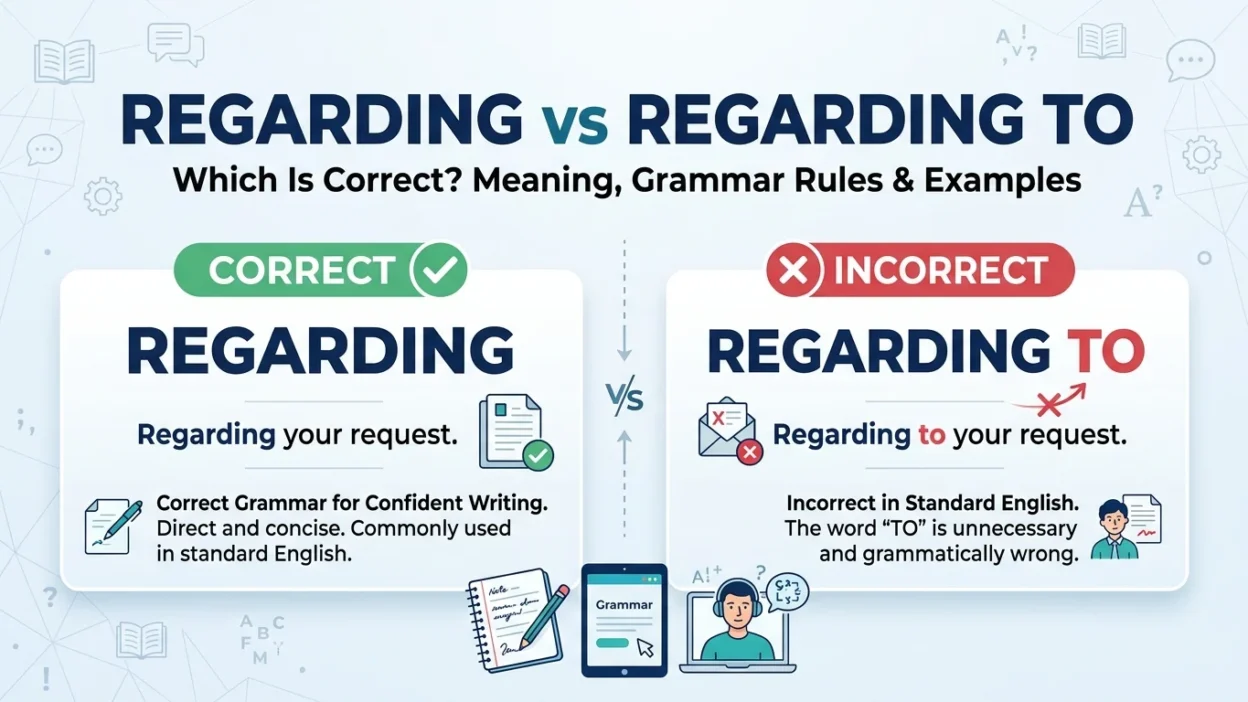
Is it correct to write regarding or regarding to? The correct choice in standard English is regarding. It means about, concerning, or in relation to something. The phrase regarding to is generally considered incorrect because regarding already functions as a preposition and does not need to after it.
Understanding the difference between regarding and regarding to can help you write clearer emails, professional letters, school assignments, reports, and everyday messages. Although both forms may appear in writing by English learners, only regarding is the standard choice when introducing a topic. For example, you should write I am writing regarding your application, not I am writing regarding to your application.
In this guide, you will learn the meaning of regarding, why regarding to is usually incorrect, how to use the word naturally, and which alternatives you can choose in different situations. Simple explanations, practical examples, and common mistakes will help you use the correct expression with confidence.
Quick Answer
Regarding is correct, while regarding to is generally incorrect in standard English. Use regarding to mean about or concerning something. For example, write I have a question regarding your order. You can also use alternatives such as about, concerning, or with regard to.
Why Do People Confuse Regarding and Regarding To?
People often confuse these expressions because English uses several similar phrases to introduce a topic. Expressions such as regarding, with regard to, in regard to, and in relation to have similar meanings but follow different grammatical patterns.
The main source of confusion is the word to. It appears in many common expressions, including according to, with respect to, and in relation to. Writers may incorrectly add it after regarding because these phrases sound similar.
Compare the following examples:
- Correct: I am contacting you regarding the meeting.
- Incorrect in standard usage: I am contacting you regarding to the meeting.
- Correct: I am contacting you with regard to the meeting.
- Correct: According to the schedule, the meeting starts at noon.
The key is to learn each expression as a complete grammatical structure rather than combining parts of similar phrases.
1. Regarding: Meaning and Usage
Regarding is a preposition that means about, concerning, or in relation to a particular subject. It introduces the topic that a sentence, message, question, or discussion is connected to.
It is common in professional emails, formal letters, business communication, academic writing, and everyday English. Although it can sound slightly more formal than about, it is widely understood and appropriate in many situations.
When Should You Use Regarding?
Use regarding when you want to introduce the subject of a message or discussion.
Examples include:
- Regarding your application, we will contact you soon.
- I have a question regarding the assignment.
- She sent an email regarding the upcoming event.
- We need more information regarding the project.
- The manager spoke to us regarding the new policy.
Is Regarding Formal or Informal?
Regarding is suitable for both formal and neutral communication, although it is especially common in professional writing.
For a formal email, you might write:
I am writing regarding the status of my application.
For a casual message, you could write:
I have a question about your plans.
Both sentences are correct. The best choice depends on the tone you want to create.
2. Regarding To: Meaning and Usage
Regarding to is generally incorrect in standard English when you intend to mean about or concerning. The word regarding already performs the grammatical role of a preposition, so adding to after it is unnecessary.
For example:
- Incorrect: I am writing regarding to your request.
- Correct: I am writing regarding your request.
The incorrect form often occurs when writers combine regarding with expressions such as with regard to or in relation to.
Why Is Regarding To Incorrect?
The issue is grammatical structure. Regarding can introduce a noun phrase directly, so it does not need an additional preposition.
Correct structures include:
- Regarding the issue
- Regarding your question
- Regarding the new schedule
- With regard to the issue
- In relation to your question
Notice that to belongs to the complete expression with regard to, not to regarding by itself.
Can Regarding To Ever Be Correct?
In ordinary modern English, avoid regarding to when you mean about or concerning. If you encounter it in a sentence, check whether the writer intended to use regarding or a different expression such as with regard to.
For clear and professional writing, choose one correct structure and use it consistently.
Comparison Table: Regarding vs Regarding To
| Feature | Regarding | Regarding To |
|---|---|---|
| Grammatical status | Correct | Generally incorrect in standard English |
| Meaning | About or concerning | Usually intended to mean about |
| Formal writing | Appropriate | Avoid |
| Business emails | Appropriate | Avoid |
| Example | Regarding your request, we need more details. | Incorrect: Regarding to your request, we need more details. |
| Better alternative | Regarding your request | With regard to your request |
Remember: Use regarding alone or use the complete expression with regard to. Do not combine them into regarding to.
When to Use Each Expression
Because regarding to is generally incorrect, the practical choice is between regarding and other correct expressions that communicate a similar meaning.
Use Regarding for a Direct and Professional Message
Choose regarding when introducing a subject in an email, report, letter, or discussion.
Examples:
- I am contacting you regarding your payment.
- Please review the documents regarding the contract.
- We received your complaint regarding the service.
Use About for Everyday Communication
About is a simple, natural alternative that works in most casual and many professional situations.
Examples:
- I have a question about your order.
- We talked about the new project.
- She asked about the meeting time.
Use With Regard To for a More Formal Tone
With regard to is a correct expression that means concerning or in relation to.
Examples:
- With regard to your request, we need additional information.
- With regard to the budget, the team will provide an update.
Use Concerning for a Direct Alternative
Concerning has a meaning similar to regarding and is suitable for formal or neutral writing.
Example: We received your message concerning the delivery date.
15 Examples of Regarding vs Regarding To
The following examples show how to use regarding correctly and how to replace the incorrect phrase regarding to.
- Correct: I am writing regarding your recent inquiry.
- Incorrect: I am writing regarding to your recent inquiry.
- Correct: We need clarification regarding the deadline.
- Incorrect: We need clarification regarding to the deadline.
- Correct: She sent a message regarding the meeting.
- Incorrect: She sent a message regarding to the meeting.
- Correct: The manager asked questions regarding the report.
- Incorrect: The manager asked questions regarding to the report.
- Correct: I have some concerns regarding your proposal.
- Incorrect: I have some concerns regarding to your proposal.
- Correct: Regarding your application, we will respond next week.
- Correct alternative: With regard to your application, we will respond next week.
- Correct alternative: About your application, we will respond next week.
- Correct: Please contact us regarding any changes.
- Correct alternative: Please contact us if you have questions about any changes.
These examples show that removing to after regarding usually fixes the problem. In some cases, rewriting the sentence with about or with regard to can also make the message sound more natural.
Common Mistakes to Avoid
Learning the correct expression is easier when you understand the mistakes that often lead to regarding to.
Mistake 1: Adding To After Regarding
Incorrect: I called regarding to the payment.
Correct: I called regarding the payment.
Why: Regarding already introduces the subject, so the additional to is unnecessary.
Mistake 2: Confusing Regarding With With Regard To
Incorrect: Regarding to your email, I have a question.
Correct: Regarding your email, I have a question.
Also correct: With regard to your email, I have a question.
Why: Regarding and with regard to are separate grammatical constructions.
Mistake 3: Assuming Every Formal Expression Needs To
Incorrect: The report contains information regarding to the policy.
Correct: The report contains information regarding the policy.
Why: Formal language does not automatically require the preposition to.
Mistake 4: Using Regarding When About Sounds More Natural
Overly formal for a casual message: I want to talk regarding our plans.
More natural: I want to talk about our plans.
Why: Regarding is correct, but about is often more conversational.
Mistake 5: Using Multiple Expressions Together
Awkward: With regarding to the new rules, we need an update.
Correct: Regarding the new rules, we need an update.
Also correct: With regard to the new rules, we need an update.
Why: Choose one complete expression instead of mixing grammatical patterns.
Memory Trick: How to Remember the Correct Form
Use this simple rule:
Regarding = About
You can replace regarding with about to check whether the sentence makes sense.
- Regarding your order → About your order
- Regarding the meeting → About the meeting
- Regarding the application → About the application
Now remember the second rule:
With regard to = Regarding
Both expressions can introduce a subject.
- Regarding your request, we need more details.
- With regard to your request, we need more details.
Do not add to directly after regarding. Think of regarding and with regard to as two separate expressions.
American vs British English
The distinction between regarding and regarding to is generally the same in American and British English. In both varieties, regarding is correct when it means about or concerning, while regarding to is not the standard construction.
| Expression | American English | British English |
|---|---|---|
| Regarding the meeting | Correct | Correct |
| Regarding to the meeting | Generally incorrect | Generally incorrect |
| With regard to the meeting | Correct | Correct |
| In regard to the meeting | Correct | Correct |
| About the meeting | Correct | Correct |
There is no meaningful American-versus-British spelling difference here. The main issue is choosing the correct grammatical expression.
Similar Words and Expressions
Several words and phrases can replace regarding, depending on the sentence and desired tone.
1. About
A common, everyday word meaning concerning a subject.
Example: I have a question about your report.
2. Concerning
A formal or neutral alternative to regarding.
Example: We received an update concerning the project.
3. With Regard To
A formal expression meaning in relation to or concerning.
Example: With regard to your application, the review is still in progress.
4. In Regard To
Another correct expression meaning concerning a particular topic.
Example: I am contacting you in regard to the payment.
5. In Relation To
Used to explain a connection between something and a particular subject.
Example: The company issued a statement in relation to the new policy.
6. As For
Often used to introduce or shift attention to a particular topic.
Example: As for the meeting, we will confirm the time tomorrow.
7. On the Subject Of
A clear phrase for introducing a topic, particularly in conversation or explanatory writing.
Example: On the subject of your application, we have received an update.
Final Verdict: Regarding vs Regarding To
Regarding is correct; regarding to is generally incorrect in standard English. Use regarding when you mean about or concerning something.
For example:
- Correct: I am writing regarding your request.
- Incorrect: I am writing regarding to your request.
- Correct alternative: I am writing with regard to your request.
If you want a simpler or more conversational tone, about is also an excellent choice. For formal emails and professional documents, regarding and with regard to are both appropriate.
FAQs
1. Is regarding to grammatically correct?
Generally, no. When you mean about or concerning, use regarding without to. For example, write regarding your application, not regarding to your application.
2. What is the correct alternative to regarding to?
Use regarding, about, concerning, or with regard to. The best option depends on the sentence and the level of formality you want.
3. Can I start a sentence with regarding?
Yes. You can start a sentence with regarding when introducing its topic. For example, Regarding your request, we will respond shortly.
4. Is regarding formal English?
Yes, regarding is appropriate in formal English and is also used in neutral communication. It is common in business emails, reports, letters, and professional messages.
5. What is the difference between regarding and with regard to?
Both expressions mean about or concerning. However, regarding is used alone, while with regard to is a complete phrase. Both are correct, but regarding to is generally incorrect.
6. Is regarding to incorrect in American and British English?
Yes, it is generally considered incorrect in standard American and British English when used to mean about or concerning. Use regarding or with regard to instead.
7. Can I use about instead of regarding?
Yes. About is a natural alternative in most contexts. It often sounds more conversational, while regarding may sound more formal or businesslike.
Remember This
- Regarding: Correct; means about or concerning.
- Regarding to: Generally incorrect in standard English.
- With regard to: Correct formal expression.
- About: Correct and commonly used alternative.
- Concerning: Another suitable alternative.
The simplest rule is to write regarding your request, never regarding to your request, when you mean about your request.
Conclusion
The difference between regarding and regarding to is simple once you understand their grammatical structure. Regarding already means about or concerning, so it does not need the additional preposition to. Using the correct form helps your emails, reports, assignments, and professional messages sound clear and natural.
When writing, choose regarding for a professional tone, about for everyday communication, or with regard to for a more formal expression. Remembering these alternatives will help you avoid a common English mistake and communicate your ideas with greater confidence.

Gabriel John is a language enthusiast and grammar writer at Synolexes. He creates clear, practical content on English grammar, vocabulary, and writing, helping learners improve communication skills with confidence.


