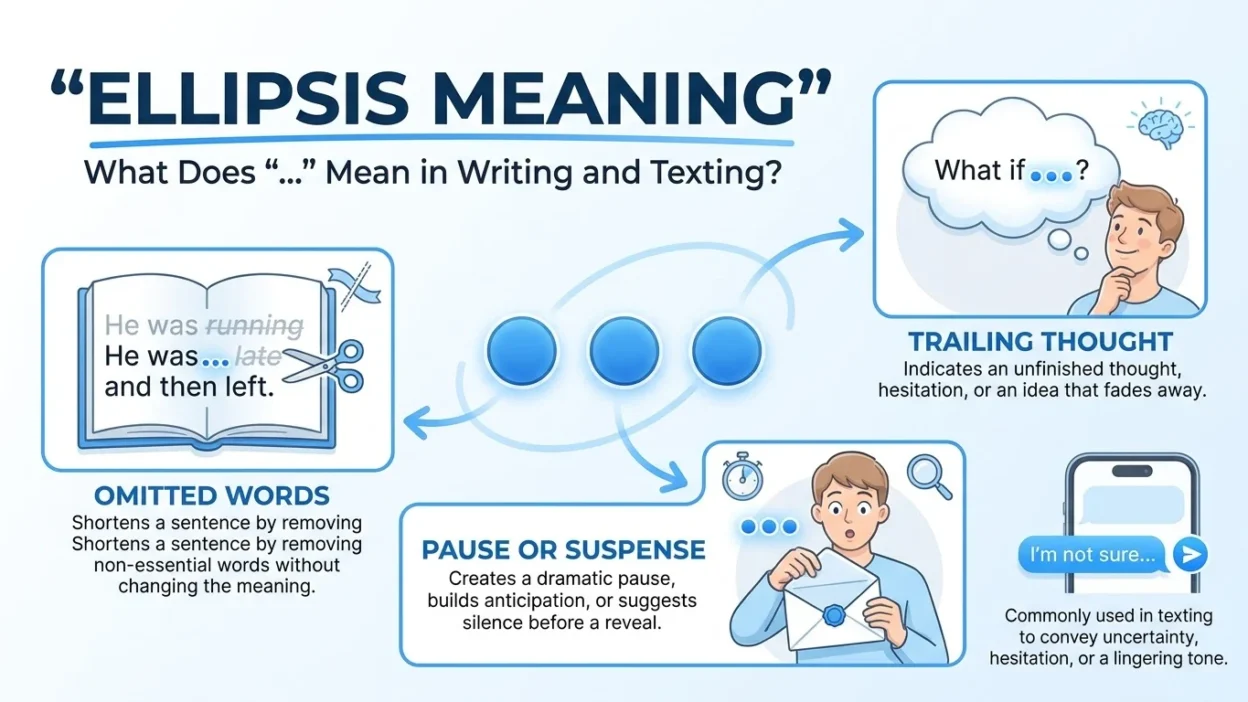
An ellipsis is a punctuation mark made of three dots: …. It can show that words have been left out of a quotation, that a thought trails off, or that a pause or hesitation occurs in writing. In texting, an ellipsis may also suggest uncertainty, suspense, or an unfinished thought—but its meaning depends on context and tone.
You may see an ellipsis in books, articles, messages, and online conversations. In formal writing, it often indicates omitted words or a deliberate pause. In casual messages, it can make a sentence feel hesitant, dramatic, or open-ended. Because the same three dots can serve different purposes, readers need to consider the surrounding words and situation.
This guide explains the meaning of ellipsis, how to use it correctly, and how it differs from similar punctuation marks. Simple examples will help you recognize what an ellipsis communicates in writing and everyday texting.
Quick Answer
An ellipsis is a punctuation mark consisting of three dots (…). It shows that words have been omitted, that a sentence or thought trails off, or that a pause is being used for effect. In texting, it can suggest hesitation, suspense, or an unfinished message. Its exact meaning depends on context.
Why People Confuse Ellipsis
People may confuse the meaning of an ellipsis because it has several uses. In a quotation, it can show that part of the original text was omitted. In a sentence, it can indicate that a speaker’s thought fades away. In a text message, it may convey hesitation or leave a thought unfinished.
The dots do not have one fixed emotional meaning. For example, “I guess…” may sound uncertain, while “And the winner is…” creates suspense. The words and situation help readers understand the intended effect.
What Is an Ellipsis?
An ellipsis is a punctuation mark made up of three dots. The plural form is ellipses.
The mark can be written as a single character (…) or as three periods (…). Both forms are widely recognized, though a particular style guide or publication may prefer one format.
The word ellipsis can also refer to the omission itself—the words or information left out of a sentence or quotation.
What Does an Ellipsis Mean in Writing?
In writing, an ellipsis commonly has three uses.
1. It Shows Omitted Words
An ellipsis can indicate that part of a quotation has been removed.
Example:
Original: The report states that the project is important, that the team should review the results, and that further research is needed.
With an ellipsis: The report states that the project is important … and that further research is needed.
The dots show that some words from the original sentence have been left out.
2. It Shows a Trailing-Off Thought
An ellipsis can suggest that a speaker stops before finishing a sentence.
Example:
- I thought I had everything ready, but…
- If only we had known…
- I’m not sure what to say…
The reader understands that the thought is unfinished or deliberately left hanging.
3. It Creates a Pause or Suspense
Writers sometimes use an ellipsis to create a pause or build anticipation.
Example:
- She opened the envelope and saw…
- There was only one thing left to do…
- I have something important to tell you…
The pause encourages the reader to wait for what comes next.
Ellipsis Meaning in Texting
In text messages, an ellipsis can suggest a pause, hesitation, uncertainty, or an unfinished thought. It may also be used to create suspense or soften a statement.
For example:
- “I’m not sure…” may suggest hesitation.
- “Well…” may show that the sender is thinking or unsure how to respond.
- “You’ll never guess…” creates anticipation.
However, an ellipsis does not automatically mean that someone is angry, upset, or being passive-aggressive. The sender’s usual writing style and the conversation matter. If the meaning is unclear, it is better not to assume a negative tone from the punctuation alone.
Ellipsis vs. Other Punctuation Marks
| Punctuation mark | Main purpose | Example |
|---|---|---|
| Ellipsis (…) | Shows omitted words, a trailing thought, or a pause | I thought you said… |
| Period (.) | Ends a statement | I thought you said that. |
| Comma (,) | Separates parts of a sentence or marks a brief pause | I thought, for a moment, that you had left. |
| Em dash (—) | Marks a break, interruption, or sudden change | I thought you said—but never mind. |
| Question mark (?) | Marks a direct question | What did you say? |
An ellipsis usually suggests that something has been left out or left unsaid. A period simply ends a statement, while an em dash often signals a sharper break or interruption.
When to Use an Ellipsis
Use an ellipsis when it helps the reader understand what has been omitted or how a sentence should sound.
Use It to Show Omitted Words
Use an ellipsis when shortening a quotation, while making sure the omission does not change the original meaning.
Example: The author argues that “careful planning … can reduce unnecessary delays.”
Use It for a Trailing Thought
Use an ellipsis when a sentence intentionally fades out or leaves an idea unfinished.
Example: I wanted to explain, but I couldn’t find the right words…
Use It to Create Suspense
Use an ellipsis when you want a pause before revealing something.
Example: When the door finally opened, everyone saw…
Use It Sparingly in Formal Writing
In formal writing, use an ellipsis only when it serves a clear purpose, such as marking an omission in a quotation. Avoid using it repeatedly to replace clear punctuation or complete sentences.
15 Examples of Ellipsis
- I thought you were coming, but…
- She looked at the letter and whispered, “It can’t be…”
- The article explains that “regular practice … improves confidence.”
- Well… I suppose we could try again.
- He opened the box and found…
- I have something to tell you…
- The instructions say to “turn off the device … before cleaning it.”
- If only I had checked the address…
- “I never said that…” she replied.
- The room was quiet, the lights were dim, and then…
- I’m not sure whether this is the right choice…
- The witness stated that the car was “dark … and moving quickly.”
- You might want to think about that…
- The final clue was hidden inside…
- I was going to call you, but I got busy.
Common Mistakes with Ellipses
1. Using Too Many Dots
An ellipsis normally has three dots, not a long string of periods.
Preferred: I’m not sure…
Avoid: I’m not sure…………
2. Using an Ellipsis Instead of Every Kind of Punctuation
An ellipsis is not a general replacement for commas, periods, or dashes. Choose punctuation that clearly expresses the intended meaning.
3. Assuming It Always Shows Anger
An ellipsis can suggest hesitation or an unfinished thought, but it does not have one universal emotional meaning. Consider the full message and the sender’s style.
4. Changing the Meaning of a Quotation
When using an ellipsis to shorten a quotation, do not remove words in a way that misrepresents what the original speaker or writer meant.
5. Using It Too Often in Formal Writing
Frequent ellipses can make writing seem vague or overly dramatic. Use them only when omission, hesitation, or a deliberate pause is important.
Memory Trick: Remember the Three Dots
Think of an ellipsis as three dots that leave something open.
- Omitted: Some words have been left out.
- Unfinished: A thought trails off.
- Paused: The writer creates a pause or suspense.
If the dots show that something is missing, unfinished, or deliberately delayed, an ellipsis may be the right choice.
American vs. British English
The basic uses of an ellipsis are similar in American and British English. Both varieties use it to show omitted words, a trailing thought, or a pause.
Formatting can vary by publication or style guide. Some prefer the single ellipsis character (…), while others use three periods (…). Spacing around the mark may also differ depending on the style rules being followed.
For formal writing, follow the style guide required by your school, workplace, or publisher.
Similar Words and Related Punctuation
Ellipsis vs. Ellipses
- Ellipsis is singular: one punctuation mark.
- Ellipses is plural: more than one.
Example: The editor removed a phrase with an ellipsis. Several ellipses appear in the passage.
Ellipsis vs. Omission
An omission is something left out. An ellipsis is a punctuation mark that can show an omission in writing.
Ellipsis vs. Em Dash
An ellipsis often suggests a pause, a trailing thought, or omitted words. An em dash often signals an interruption, a sudden change, or a stronger break.
Example with an ellipsis: I thought you were going to…
Example with an em dash: I thought you were going to—never mind.
Final Verdict
An ellipsis is a punctuation mark made of three dots. It can show that words have been omitted, that a thought trails off, or that a pause is being used for suspense or effect.
In texting, an ellipsis may suggest hesitation or an unfinished thought, but it does not automatically indicate a particular emotion. The clearest interpretation comes from the words around it and the context of the conversation.
FAQs
1. What does an ellipsis (…) mean?
An ellipsis is three dots used to show omitted words, a trailing thought, or a pause. Its meaning depends on the sentence and context.
2. What does an ellipsis mean in texting?
In texting, it may suggest hesitation, uncertainty, suspense, or an unfinished thought. It does not always mean the sender is upset.
3. Is an ellipsis always three dots?
An ellipsis is traditionally represented by three dots. It may appear as the single character (…) or as three periods (…), depending on the typing method or style guide.
4. What is the plural of ellipsis?
The plural of ellipsis is ellipses.
5. How do you use an ellipsis in a sentence?
Use it to show that words have been omitted, that a thought trails off, or that a pause is intentional. For example: “I wanted to tell you, but…”
6. Is an ellipsis the same as a period?
No. A period ends a statement. An ellipsis can show omitted words, an unfinished thought, or a deliberate pause.
7. Can an ellipsis sound rude in a text?
It can sometimes be read as cold, hesitant, or annoyed, but that depends on context and the sender’s style. The punctuation alone does not prove a particular emotion.
Remember This
An ellipsis is three dots (…). It can show omitted words, an unfinished thought, or a pause. In messages, its tone depends on context—so do not assume the dots always mean something negative.
Conclusion
The meaning of an ellipsis depends on how it is used. In formal writing, it often marks omitted words in a quotation. In everyday writing and texting, it can show hesitation, a trailing thought, or a pause that creates suspense.
Use an ellipsis when something is intentionally left out or left unsaid. Keep it clear and consistent, especially in formal writing, and use the surrounding words to help readers understand what the dots mean.

Gabriel John is a language enthusiast and grammar writer at Synolexes. He creates clear, practical content on English grammar, vocabulary, and writing, helping learners improve communication skills with confidence.