The words assent and consent are closely related because both express agreement or approval. However, they are not always interchangeable. Understanding the difference between assent vs consent can help you choose the correct word in everyday conversations, formal writing, legal discussions, and academic contexts.
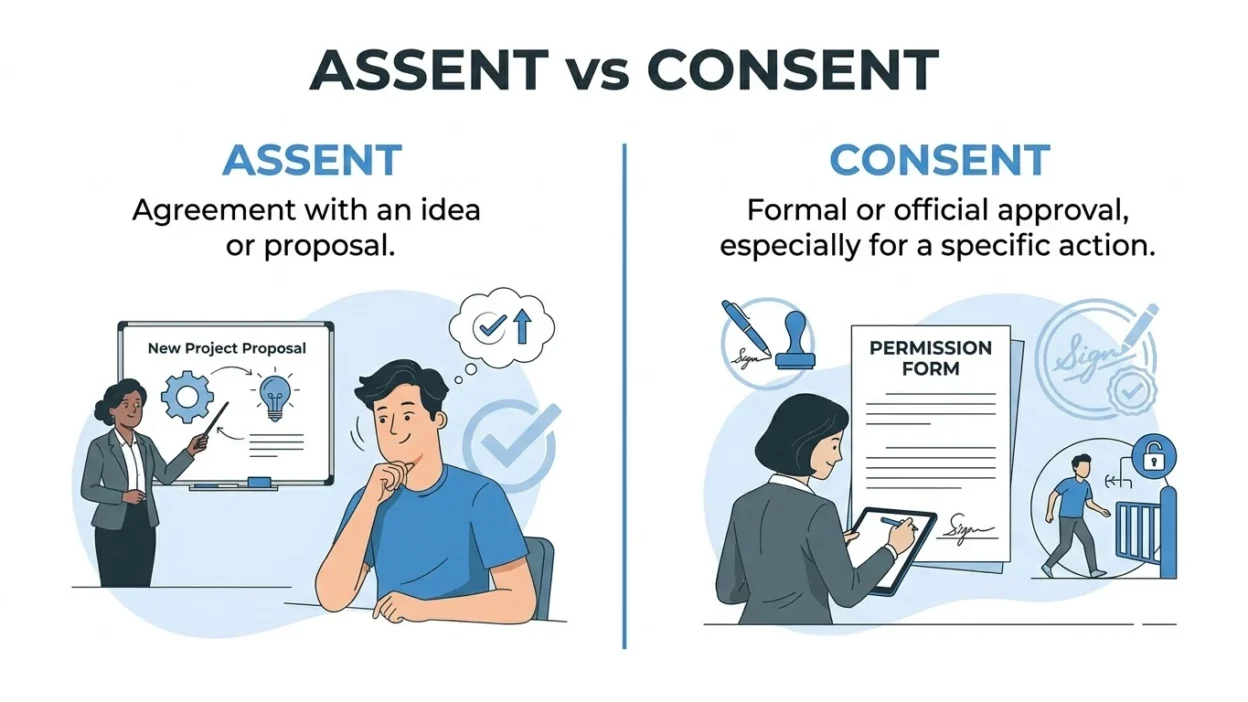
The main difference is that assent means agreeing with a suggestion, proposal, or opinion, while consent means giving permission or agreeing to something being done. For example, a person may assent to a plan because they agree with it, but they may consent to a medical procedure because they give permission for it to happen. Both words can describe agreement, but they often appear in different situations. Learning when to use each word will make your English clearer and more precise.
Quick Answer
Assent means agreement with an idea, opinion, or proposal. Consent means permission or approval for an action to take place. Assent usually emphasizes agreement, while consent often emphasizes authorization. Although both words can overlap, consent is more commonly used when someone gives permission for something to happen.
Why Do People Confuse Assent and Consent?
People often confuse assent and consent because both words describe a positive response or agreement.
For example, if someone agrees to a suggestion, they might assent to it. If someone gives another person permission to do something, they might consent to it.
There are three main reasons these words are confusing:
- Similar meanings: Both words can communicate agreement or approval.
- Overlapping situations: A person may agree to a proposal and give permission at the same time.
- Formal usage: Both words appear in legal, academic, professional, and official contexts.
The easiest way to distinguish them is to remember that assent focuses on agreement, while consent usually focuses on permission.
First Word: Assent – Meaning, Definition, and Usage
Assent means to agree with, approve of, or accept an idea, suggestion, statement, or proposal.
It can be used as both a noun and a verb.
Assent as a Noun
As a noun, assent refers to agreement or approval.
Examples:
- The committee gave its assent to the proposal.
- Her parents expressed their assent.
- The plan received unanimous assent.
- He nodded in silent assent.
Assent as a Verb
As a verb, assent means to agree with something or express approval.
Examples:
- She assented to the suggestion.
- The manager assented to the new arrangement.
- He assented with a quiet nod.
- They assented to the proposed changes.
When Should You Use Assent?
Use assent when someone:
- Agrees with an idea or opinion.
- Accepts a suggestion or proposal.
- Expresses approval of a decision.
- Shows agreement through words, gestures, or actions.
Simple example: The teacher suggested a new activity, and the students assented to the idea.
Second Word: Consent – Meaning, Definition, and Usage
Consent means giving permission, approval, or agreement for something to happen or be done.
It can also be used as both a noun and a verb.
Consent as a Noun
As a noun, consent refers to permission or agreement.
Examples:
- You need parental consent to participate.
- She gave her consent to the procedure.
- The school requested written consent from parents.
- The activity cannot begin without consent.
Consent as a Verb
As a verb, consent means to give permission or agree to something.
Examples:
- He consented to the medical examination.
- She consented to the arrangement.
- They consented to share their information.
- The parents consented to the school trip.
When Should You Use Consent?
Use consent when someone:
- Gives permission for an action.
- Authorizes a procedure or activity.
- Agrees to share personal information.
- Allows something to happen.
- Gives formal or informed approval.
Simple example: The patient gave consent before the doctor performed the procedure.
Assent vs Consent: Comparison Table
| Feature | Assent | Consent |
|---|---|---|
| Main meaning | Agreement or approval | Permission or authorization |
| Main focus | Agreeing with an idea | Allowing an action |
| Part of speech | Noun and verb | Noun and verb |
| Common contexts | Proposals, opinions, decisions | Medical, legal, personal, and official matters |
| Example | She assented to the plan. | She consented to the procedure. |
| Related expression | Give one’s assent | Give one’s consent |
Both words communicate agreement, but consent generally places greater emphasis on permission.
When to Use Assent vs Consent
Choosing between assent and consent depends on what kind of agreement you want to describe.
Use Assent When Talking About Agreement
Choose assent when someone agrees with an idea, suggestion, opinion, or proposal.
Examples:
- The board gave its assent to the proposal.
- He assented to his friend’s suggestion.
- The members nodded in assent.
In these examples, the focus is on accepting or agreeing with an idea.
Use Consent When Talking About Permission
Choose consent when someone allows an action to happen or gives permission for something.
Examples:
- The patient consented to the treatment.
- Parents must provide consent for the trip.
- She gave consent to the recording.
Here, the focus is on permission or authorization.
Can Assent and Consent Mean the Same Thing?
Sometimes, yes. Both words can describe agreement or approval, especially in formal situations.
However, they are not always interchangeable. In medical, legal, and personal situations, consent often has a specific meaning involving permission. Assent may describe agreement without necessarily providing the same formal authorization.
For example, a child may express assent to a medical procedure, while a parent or legally authorized representative may need to provide consent, depending on the applicable rules.
15 Examples of Assent vs Consent in Sentences
These examples show how to use both words correctly in everyday and formal English.
Examples Using Assent
- The committee gave its assent to the new policy.
- She nodded in assent when the teacher explained the plan.
- He assented to the proposal without hesitation.
- The members expressed their assent through a unanimous vote.
- My parents gave their assent to my decision.
- The manager assented to the suggested changes.
- Everyone waited for the director’s assent before proceeding.
- Her silence was interpreted as assent in that discussion.
Examples Using Consent
- The patient gave consent before the operation.
- Parents must provide written consent for the school trip.
- She consented to having her photograph taken.
- The company requested consent before collecting personal information.
- He did not consent to the agreement.
- The doctor explained the risks before asking for consent.
- The participants gave their consent to join the research study.
Common Mistakes When Using Assent and Consent
Even experienced English speakers sometimes use these words incorrectly. Here are some common mistakes to avoid.
1. Treating Both Words as Completely Interchangeable
Assent and consent have related meanings, but they do not always express the same kind of agreement.
Incorrect distinction: She gave her assent to the medical procedure when the intended meaning is that she formally authorized it.
Better: She gave her consent to the medical procedure.
2. Using Consent When You Mean Agreement With an Opinion
If someone agrees with an opinion or suggestion, assent may be more suitable.
Less natural: He consented to my opinion.
Better: He assented to my suggestion.
3. Assuming Silence Always Means Consent
Silence does not automatically mean someone has given permission. Consent generally requires a valid expression of agreement, although the applicable rules can vary by situation and jurisdiction.
4. Forgetting That Both Words Can Be Verbs and Nouns
Both words can function as nouns and verbs.
- Noun: The proposal received their assent.
- Verb: They assented to the proposal.
- Noun: We need your consent.
- Verb: They consented to the arrangement.
Memory Trick: How to Remember Assent vs Consent
Use this simple memory trick:
- Assent = Agreement: Think of agreeing with an idea or suggestion.
- Consent = Permission: Think of allowing something to happen.
Remember these two examples:
- I assent to your idea.
- I consent to your request to record me.
The first expresses agreement with an idea. The second expresses permission for an action.
American vs British English: Assent and Consent
There is no major spelling difference between American and British English for these words.
Both forms are spelled the same:
- Assent
- Consent
Their meanings and general usage are also similar in both varieties of English.
Examples:
- American English: The patient gave consent to the treatment.
- British English: The patient gave consent to the treatment.
Both are correct.
The words may appear in slightly different legal or institutional contexts depending on the country, but their basic meanings remain consistent.
Similar Words to Assent and Consent
Several English words are related to assent and consent. However, each has its own meaning and usage.
| Word | Meaning | Example |
|---|---|---|
| Agreement | A shared understanding or acceptance | We reached an agreement. |
| Approval | Official or personal acceptance | The manager gave approval. |
| Permission | Authorization to do something | I received permission to leave. |
| Authorization | Formal power or approval to act | The form requires authorization. |
| Acceptance | Willingness to receive or agree to something | She showed acceptance of the decision. |
| Endorsement | Public or official support | The proposal received strong endorsement. |
| Approval | A positive judgment or decision | The plan received approval. |
Important distinction: Agreement and approval are close to assent, while permission and authorization are particularly close to consent.
Final Verdict: Assent or Consent?
The correct word depends on the meaning you want to express.
Use assent when someone agrees with an idea, opinion, suggestion, or proposal. Use consent when someone gives permission or authorizes an action.
For example:
- The students assented to the teacher’s suggestion.
- The parents consented to the school trip.
Both sentences are correct because each word describes a different kind of agreement. Remembering the distinction between agreement and permission will help you use assent and consent naturally and accurately.
FAQs
1. What is the main difference between assent and consent?
Assent means agreement with an idea, opinion, or proposal. Consent means permission or authorization for something to happen. Both involve agreement, but consent usually emphasizes permission.
2. Are assent and consent synonyms?
Yes, they are related words and can sometimes overlap in meaning. However, they are not always interchangeable. Assent generally emphasizes agreement, while consent emphasizes permission or authorization.
3. Is assent the same as permission?
Not exactly. Assent means expressing agreement or approval. Permission means allowing someone to do something. Consent is generally closer in meaning to permission than assent is.
4. What is an example of assent?
An example is: The committee gave its assent to the proposed changes. In this sentence, assent means the committee agreed with or approved the proposal.
5. What is an example of consent?
An example is: The patient gave consent before the medical procedure. Here, consent means the patient gave permission for the procedure.
6. Can assent and consent be used as verbs?
Yes. Both words can be used as verbs.
- Assent: She assented to the proposal.
- Consent: She consented to the procedure.
7. What is the difference between assent and consent in medical situations?
In medical contexts, consent generally means giving permission for a medical procedure or treatment after receiving relevant information. Assent can describe a person’s agreement, particularly when discussing children or individuals who cannot legally provide their own consent. The exact requirements depend on the circumstances and applicable laws.
Remember This
- Assent = Agreement with an idea or proposal.
- Consent = Permission for something to happen.
- Both words can function as nouns and verbs.
- They have similar meanings but are not always interchangeable.
- Consent is especially common in medical, legal, and personal permission-related situations.
Conclusion
Understanding the difference between assent vs consent makes your English more accurate and natural. Although both words express agreement, assent usually refers to accepting an idea or proposal, while consent refers to giving permission or authorization. The context helps determine which word is appropriate.
Whenever you are unsure, remember this simple rule: use assent for agreement and consent for permission. With regular practice and attention to context, you can use both words confidently in everyday conversations, academic writing, and formal communication.