
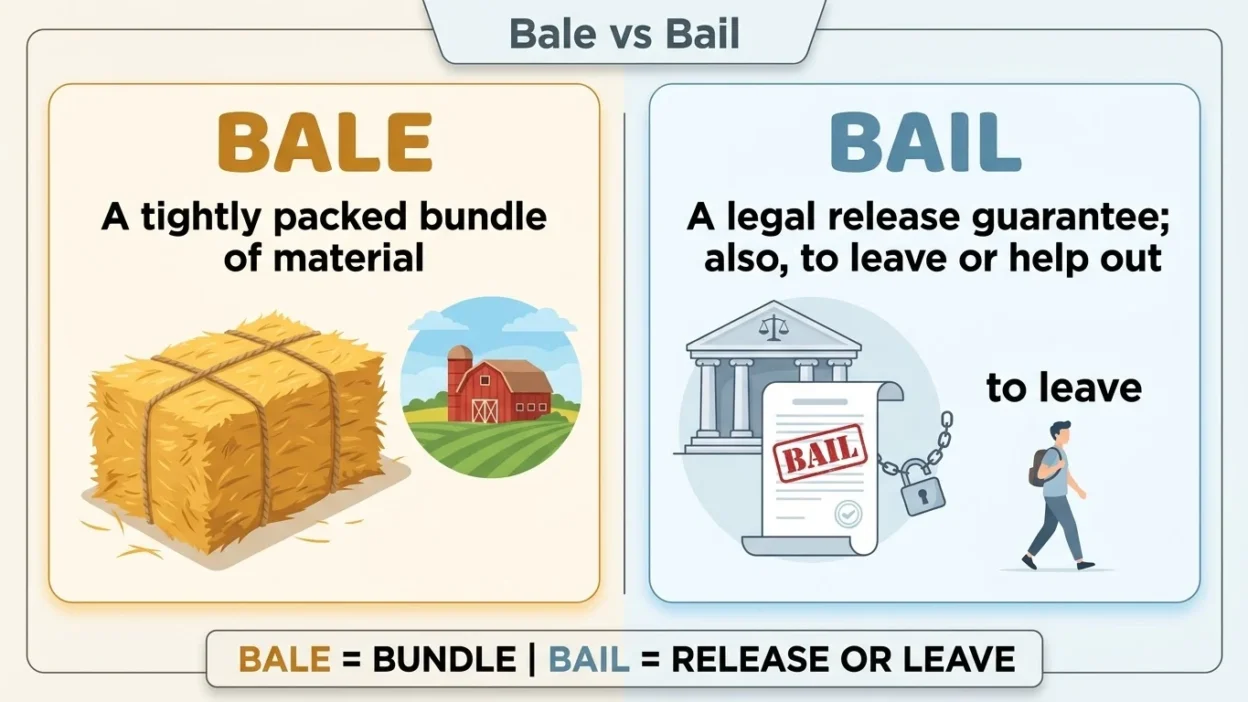
Bale and bail sound the same, but they have different meanings and uses. A bale is a large bundle of material, such as hay, straw, or cotton, pressed and tied together. Bail can mean money or a guarantee used to secure someone’s release from jail, or it can mean to leave a difficult situation. The correct word depends on what you are describing.
Because the two words are homophones, they can be easy to mix up in speech and writing. If you are talking about a bundle of hay, use bale. If you mean release from jail, use bail. In everyday English, bail also appears in phrases such as bail out and bail on someone. Learning these differences will help you spell each word correctly and understand how it is used in context.
Quick Answer
Bale means a large, tightly packed bundle of material, such as hay or cotton. Bail usually refers to money or a guarantee that allows a person accused of a crime to be released while awaiting trial. As a verb, bail can also mean to leave a situation or help someone out of trouble.
Why People Confuse Bale and Bail
People confuse bale and bail because they are pronounced the same in many varieties of English. They are homophones: words that sound alike but have different spellings and meanings.
The main differences are:
- Bale is usually a noun for a compact bundle of material.
- Bail is commonly used in legal contexts and in expressions about leaving or helping.
- Their meanings are different, even though their pronunciation is the same.
Bale: Meaning, Definition, and Usage
Bale is a noun meaning a large bundle of material that has been compressed and tied or wrapped for storage or transport.
Common materials packed into bales include:
- Hay
- Straw
- Cotton
- Paper
- Recyclable materials
Examples of Bale in Sentences
- The farmer stacked the hay bales beside the barn.
- A bale of cotton was ready for transport.
- The workers tied the straw into a large bale.
- The recycling center compressed the paper into bales.
- The horse ate hay from a freshly opened bale.
When Is Bale Used?
Use bale when you mean a compact bundle of material, especially one that has been pressed and tied together.
Bail: Meaning, Definition, and Usage
Bail has several meanings. As a noun, it often refers to money or a guarantee that allows someone accused of a crime to be released from custody while their case continues. The exact rules and conditions depend on the legal system and the case.
As a verb, bail can mean to secure someone’s release by providing bail, to remove water from a boat, or—informally—to leave a situation.
Examples of Bail in Sentences
- The judge set bail for the accused.
- Her family helped arrange bail.
- We had to bail water out of the boat.
- He decided to bail on the plan at the last minute.
- The company stepped in to bail out the struggling business.
When Is Bail Used?
Use bail when you mean:
- Money or a guarantee connected with release from custody.
- Helping someone out of a difficult situation.
- Leaving or withdrawing from a plan or activity, informally.
- Removing water from a boat.
Bale vs Bail: Comparison Table
| Feature | Bale | Bail |
|---|---|---|
| Pronunciation | Same as bail | Same as bale |
| Main meaning | A tightly packed bundle | A legal release guarantee or a way to leave/help |
| Common use | Hay, straw, cotton, paper | Courts, boats, informal expressions |
| Part of speech | Usually a noun | Noun and verb |
| Example | The farmer loaded a bale of hay. | The judge set bail. |
| Memory clue | A bale is a bundle | Bail can help someone get out |
When to Use Bale vs Bail
Use Bale for a Bundle
Choose bale when referring to a large bundle of material that has been compressed and tied or wrapped.
- The farm stored the hay in a bale.
- The factory shipped a bale of cotton.
- The workers loaded several bales of paper.
Use Bail for Legal Release or Other Actions
Choose bail when referring to a legal release guarantee or when using the verb in one of its other meanings.
- The judge granted bail.
- They helped bail the accused out of jail.
- We used a bucket to bail water out of the boat.
- She decided to bail on the event.
12 Examples of Bale vs Bail in Sentences
- The farmer lifted a bale of hay onto the trailer.
- The accused was released after posting bail.
- The workers stacked each bale neatly in the storage shed.
- His family helped him arrange bail.
- The cotton was packed into a heavy bale.
- We had to bail water out of the boat.
- The recycling plant pressed the cardboard into a bale.
- He said he might bail on the trip.
- A large bale of straw stood beside the fence.
- The judge decided whether to grant bail.
- The company received a government bailout to help it survive.
- The farmer wrapped the bale to keep the hay dry.
Common Mistakes
1. Writing Bail When You Mean a Bundle
Incorrect: The farmer loaded a bail of hay.
Correct: The farmer loaded a bale of hay.
Use bale for a bundle of material.
2. Writing Bale When You Mean Legal Release
Incorrect: The judge set bale.
Correct: The judge set bail.
Use bail for the legal term.
3. Confusing Bail with Bail Out
Bail can be used in the phrase bail out, but the phrase has different meanings depending on context:
- Bail someone out can mean help them out of trouble.
- Bail out of something can mean leave or withdraw from it.
- In a legal context, bail someone out can mean help secure their release from custody.
4. Assuming the Words Are Interchangeable
Although bale and bail sound alike, they refer to different things. Check the meaning of the sentence before choosing the spelling.
Memory Trick
Remember:
- Bale = Bundle. Both begin with B, and a bale is a bundle of material.
- Bail = Be released or leave. Think of bail in a legal case or the phrase bail out.
If you are talking about hay or cotton, choose bale. If you mean legal release or leaving a situation, choose bail.
American vs British English
There is no major spelling difference between American and British English. Both varieties use bale for a bundle and bail for legal release and the related verb meanings.
The legal rules and procedures for bail can differ between countries, but the basic spelling and meanings of the words are the same.
Similar Words
| Word | Meaning | Example |
|---|---|---|
| Bundle | A group of things tied or wrapped together | She carried a bundle of papers. |
| Pack | A collection of items grouped together | He carried a pack of supplies. |
| Bond | A financial or legal guarantee | The court required a bond. |
| Release | To set someone free or let something go | The court ordered his release. |
| Withdraw | To leave or pull back from something | She withdrew from the competition. |
| Abandon | To leave something behind | They abandoned the plan. |
Bale is closest in meaning to bundle when describing packed material. Bail is related to bond and release in legal contexts, and to leave or withdraw in informal use.
Final Verdict: Bale or Bail?
Use bale when you mean a large bundle of material, such as hay, straw, or cotton. Use bail when you mean a legal release guarantee, removing water from a boat, or leaving or helping in expressions such as bail out.
The simplest rule is: a bale is a bundle; bail is about release, leaving, or helping out.
FAQs
1. What is the main difference between bale and bail?
Bale means a large, tightly packed bundle of material. Bail usually refers to a legal release guarantee, but it can also mean removing water from a boat or leaving a situation.
2. Is it a bale of hay or a bail of hay?
The correct phrase is a bale of hay. A bale is a compressed bundle of hay or another material.
3. Is bail the same as bond?
Not exactly. Both terms can refer to financial or legal guarantees, but their meaning and use depend on the legal system. In everyday use, bail is the more common term for a release arrangement.
4. What does “bail out” mean?
Bail out can mean helping someone out of trouble, leaving a situation, or helping secure someone’s release from custody. The intended meaning depends on the context.
5. Are bale and bail homophones?
Yes. Bale and bail are homophones in many varieties of English because they are pronounced the same but have different spellings and meanings.
6. Can bail be used as a verb?
Yes. You can bail water out of a boat, bail someone out of trouble, or informally bail on a plan or event.
7. Does bale have a verb form?
Yes. Bale can be used as a verb meaning to press or pack material into a bale. For example: The workers baled the hay before storing it.
Remember This
- Bale means a tightly packed bundle.
- Bail can mean a legal release guarantee.
- Bail can also mean to remove water, help someone out, or leave a situation.
- Bale and bail sound alike but have different meanings.
- A bale of hay is correct; a bail of hay is not.
Conclusion
Although bale and bail sound the same, their meanings are different. Bale refers to a large bundle of material, while bail is used in legal contexts and in expressions about leaving, helping, or removing water. The context of the sentence will usually make the correct spelling clear.
Remember the simple distinction: a bale is a bundle, and bail is connected with release or getting out of a situation. Keeping that rule in mind will help you spell both words correctly.