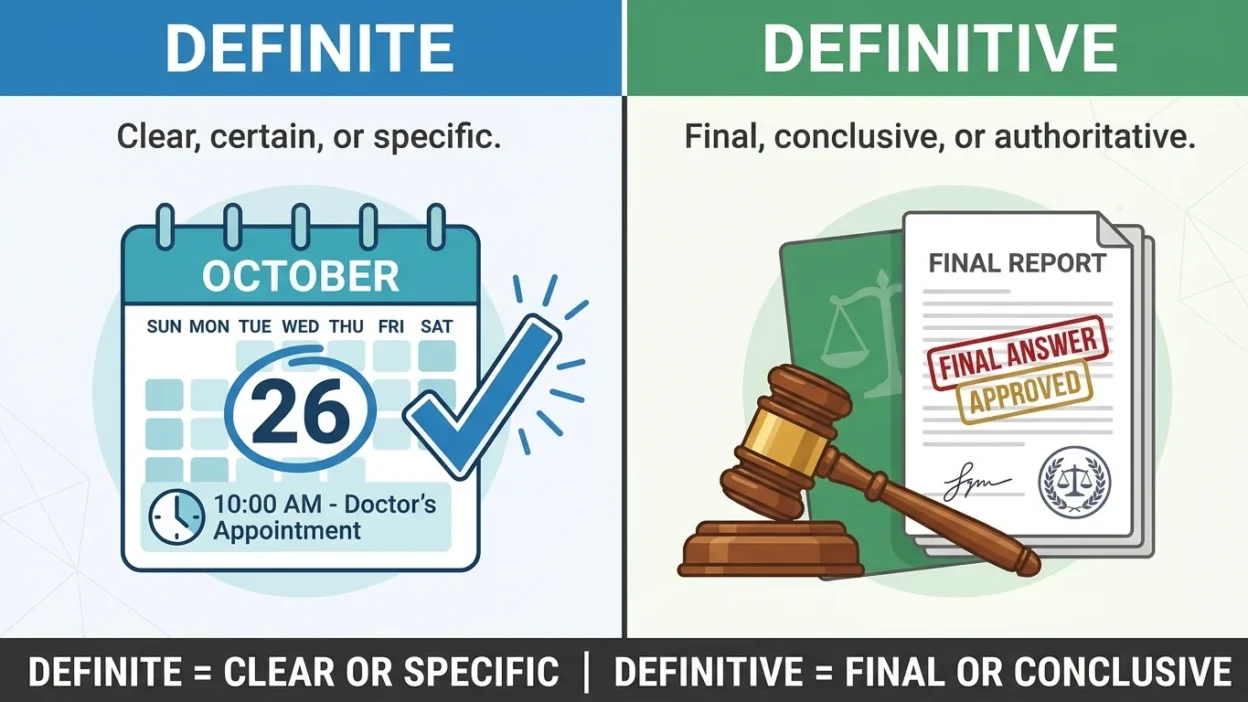
The words definite and definitive are related, but they are not interchangeable in every sentence. Definite means clear, certain, or specific. Definitive means final, authoritative, or conclusive. For example, you might have a definite plan for the weekend, but a definitive answer is one that settles a question.
Both words can describe something clear or certain, which is why they are easy to confuse. However, definite usually emphasizes that something is clearly identified or established, while definitive emphasizes that it provides the final or most authoritative result. Understanding this distinction can help you choose the right word in everyday conversation, academic writing, and professional communication.
Quick Answer
Definite means clear, certain, or specific: We have a definite date for the meeting. Definitive means final, conclusive, or authoritative: The report provides a definitive answer. Use definite for something clearly established; use definitive when something settles a matter or is regarded as the authoritative version.
Why People Confuse Definite and Definitive
People confuse these words because they share the same root and both can suggest certainty. Their meanings overlap, but each emphasizes a different quality.
- Similar spelling: Both begin with definit-.
- Related meanings: Both can describe something clear or certain.
- Different emphasis: Definite highlights clarity or specificity; definitive highlights finality or authority.
Definite: Meaning, Definition, and Usage
Definite is an adjective meaning clear, certain, specific, or clearly established.
Use it when something is known, decided, or identified without being vague.
Examples:
- We have a definite plan for Saturday.
- She gave me a definite answer.
- There is a definite improvement in his writing.
- The meeting has a definite start time.
- I have no definite opinion about the proposal yet.
Common uses of definite
- A definite date or time: a date or time that has been clearly set.
- A definite answer: an answer that is clear or certain.
- A definite improvement: a noticeable, identifiable improvement.
- A definite amount: a specific amount.
Definitive: Meaning, Definition, and Usage
Definitive is an adjective meaning final, conclusive, or authoritative. It often describes something that settles a question or is considered the most reliable account or version.
Use it when the emphasis is on reaching a final conclusion or providing an authoritative result.
Examples:
- The test gave a definitive result.
- The court issued a definitive ruling.
- This book is a definitive guide to the subject.
- The investigation found no definitive evidence.
- Researchers have not reached a definitive conclusion.
Common uses of definitive
- A definitive answer: an answer that settles the question.
- A definitive result: a result that establishes the outcome clearly.
- A definitive ruling: a final or authoritative decision.
- A definitive guide: a comprehensive, authoritative resource.
Definite vs Definitive: Comparison Table
| Feature | Definite | Definitive |
|---|---|---|
| Main meaning | Clear, certain, or specific | Final, conclusive, or authoritative |
| Emphasis | Clarity or certainty | Finality or authority |
| Common phrases | definite plan, definite date, definite answer | definitive result, definitive ruling, definitive guide |
| Example | We set a definite date. | The report gave a definitive answer. |
| Key question | Is it clear or specific? | Does it settle the matter or serve as the authority? |
When to Use Definite vs Definitive
Use definite for something clear or specific
Choose definite when you mean that something is clearly identified, certain, or settled enough to be specific.
- We need a definite time for the appointment.
- She noticed a definite change in his behavior.
- The instructions gave a definite amount to use.
Use definitive for something final or authoritative
Choose definitive when you mean that something provides a final conclusion, settles an issue, or is considered an authoritative source.
- The investigation did not produce a definitive answer.
- The judge made a definitive ruling.
- The book is a definitive account of the event.
Can they ever overlap?
Yes. A definite answer is clear or certain; a definitive answer goes further by settling the question. In some contexts, either word may sound reasonable, but the intended emphasis changes.
15 Examples of Definite vs Definitive in Sentences
- We have a definite date for the school trip.
- The scientist has not reached a definitive conclusion.
- She gave a definite answer about the meeting time.
- The report provides a definitive account of what happened.
- There was a definite improvement in his pronunciation.
- The test did not provide a definitive result.
- They made a definite plan for the weekend.
- The court issued a definitive ruling.
- I heard a definite change in her voice.
- The guide is considered a definitive resource on the topic.
- We need a definite number of volunteers.
- The evidence was not definitive enough to settle the case.
- He gave a definite promise to help.
- The study offers no definitive proof of the claim.
- The team has a definite schedule, but the final decision is not yet definitive.
Common Mistakes
1. Using definitive when you mean specific
Less natural: Please give me a definitive meeting time.
Better: Please give me a definite meeting time.
Use definite when asking for a clearly specified time.
2. Using definite when you mean final or conclusive
Less precise: The test gave a definite result that settled the question.
Better: The test gave a definitive result that settled the question.
Use definitive when the result settles the matter.
3. Assuming definitive always means “certain”
Definitive often means final or authoritative, but it does not automatically mean that a claim is true. A statement may be presented as definitive and still later be challenged or revised.
4. Treating the words as interchangeable
Both words can describe certainty, but definite emphasizes clarity or specificity, while definitive emphasizes finality or authority.
Memory Trick
Remember:
- Definite = clearly set.
- Definitive = settles it.
A definite date tells you exactly when something will happen. A definitive answer settles the question.
American vs British English
There is no difference in spelling or basic meaning between American and British English. Both varieties use definite and definitive in the same way.
- American English: The report provides a definitive answer.
- British English: The report provides a definitive answer.
Both are correct.
Similar Words
| Word | Meaning | Example |
|---|---|---|
| Certain | Known or believed to be true | I am certain about the date. |
| Specific | Clearly identified or stated | Please give a specific example. |
| Clear | Easy to understand | The instructions are clear. |
| Conclusive | Settling an issue or question | The evidence was conclusive. |
| Final | Coming at the end; not expected to change | The final decision was announced. |
| Authoritative | Reliable or officially recognized | She consulted an authoritative source. |
Definite is close to clear, certain, and specific. Definitive is closer to conclusive, final, and authoritative.
Final Verdict: Definite or Definitive?
Use definite when something is clear, certain, or specific. Use definitive when something is final, conclusive, or authoritative.
For example, a definite date is a clearly set date. A definitive answer settles a question. If you remember the difference between being specific and being conclusive, you can choose the right word with confidence.
FAQs
1. What is the main difference between definite and definitive?
Definite means clear, certain, or specific. Definitive means final, conclusive, or authoritative. A definite answer is clear; a definitive answer settles the question.
2. Are definite and definitive synonyms?
They are related, but they are not exact synonyms. Both can suggest certainty, yet definite focuses on clarity or specificity and definitive focuses on finality or authority.
3. Is it a definite answer or a definitive answer?
Both phrases are correct, but they mean slightly different things. A definite answer is clear or certain. A definitive answer is intended to settle the question.
4. What does definitive mean in simple words?
Definitive means final or conclusive. A definitive result or answer settles a matter rather than leaving it open.
5. What does definite mean in simple words?
Definite means clear, certain, or specific. For example, a definite time is a time that has been clearly set.
6. Can something be definite but not definitive?
Yes. A plan may have a definite date, meaning the date is clearly set, but it may not be definitive if the plan can still change or does not settle a larger question.
7. What is a definitive guide?
A definitive guide is a resource regarded as especially authoritative or comprehensive on a subject. The phrase suggests that it is a leading reference, not necessarily that it can never be updated.
Remember This
- Definite means clear, certain, or specific.
- Definitive means final, conclusive, or authoritative.
- A definite date is clearly set.
- A definitive answer settles a question.
- The words are related, but their emphasis is different.
Conclusion
The difference between definite and definitive is small but important. Definite describes something clearly established or specific, while definitive describes something that provides a final or authoritative conclusion. Both words can communicate certainty, but they do not always fit the same sentence.
When choosing between them, ask whether you mean “clearly specified” or “final and conclusive.” Use definite for the first meaning and definitive for the second. This simple distinction will help you use both words accurately in conversation and writing.

Gabriel John is a language enthusiast and grammar writer at Synolexes. He creates clear, practical content on English grammar, vocabulary, and writing, helping learners improve communication skills with confidence.