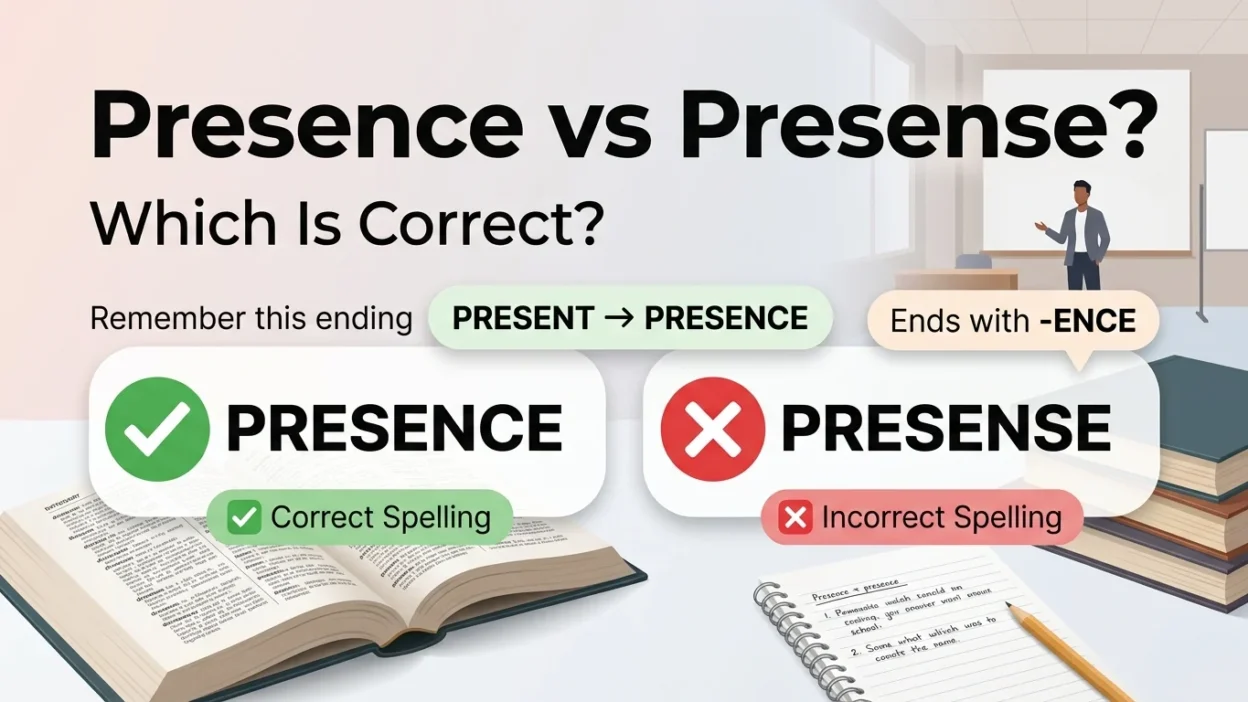
If you are wondering whether presence or presense is correct, the standard English spelling is presence. Presense is a common spelling mistake. Presence is a noun that can refer to the state of being in a particular place, the way someone appears or feels to others, or a noticeable quality or influence. For example, Her presence made everyone feel comfortable.
The confusion is understandable because presence is pronounced with an ending that can sound like -sence, while its spelling uses -ence. The word is also closely related to present, which can make its spelling easier to remember once the connection is clear. This guide explains the difference between presence and presense, shows practical examples, covers common mistakes, and gives you a simple memory trick for remembering the correct spelling.
Quick Answer
Presence is the correct spelling, while presense is incorrect in standard English. Presence means the state of being present or existing in a particular place. It can also describe someone’s noticeable appearance, influence, or effect. Remember the spelling as present → presence, with -ence at the end.
Why Do People Confuse Presence and Presense?
People often confuse presence and presense because of pronunciation.
When spoken aloud, the ending of presence can sound similar to sense, which may cause people to write presense.
There is also a strong connection between present and presence:
- present → presence
- absent → absence
- silent → silence
These related words can help you recognize the spelling pattern.
The key difference is:
presence ✅
presense ❌
First Word: Presence
Presence is the correct English word.
It is a noun with several related meanings.
Presence Meaning: Being in a Place
The most basic meaning of presence is the state of being present or being in a particular place.
Example:
Your presence is required at the meeting.
This means that you are expected to be there.
Presence Meaning: Personal Impression
Presence can also describe the strong impression someone makes when they enter or occupy a place.
Example:
The speaker had a powerful presence on stage.
This means the speaker had a noticeable or commanding effect on the audience.
Presence Meaning: Influence or Effect
The word can also describe the existence or influence of something.
Example:
The presence of security cameras made the building feel safer.
Here, presence means that the security cameras were there and had an effect on the situation.
Second Word: Presense
Presense is not the standard spelling of the English noun.
It is generally a misspelling of presence.
For example:
Her presense was appreciated. ❌
The correct sentence is:
Her presence was appreciated. ✅
The incorrect form may appear because people spell the word according to how they hear it, but standard English uses presence.
Presence vs Presense Comparison Table
| Word | Correct? | Meaning | Example |
|---|---|---|---|
| Presence | ✅ Yes | The state of being present; a noticeable quality or influence | Her presence helped everyone relax. |
| Presense | ❌ No | Common misspelling of presence | Her presense helped everyone relax. ❌ |
| Present | ✅ Yes | Existing, attending, or happening now | She was present at the meeting. |
| Absence | ✅ Yes | The state of not being present | His absence was noticed. |
When Should You Use Each?
Use Presence in Standard English
Use presence whenever you mean the state of being present or someone’s noticeable effect or impression.
Example:
The teacher noticed his presence in the classroom.
Use Presence for Attendance
Example:
The manager requested everyone’s presence at the meeting.
Here, presence means being there.
Use Presence for Personal Impact
Example:
She has a confident presence.
Here, the word describes the impression she makes.
Use Presence for the Existence of Something
Example:
The presence of water was confirmed.
Here, presence means that something exists or is found in a particular place.
Do Not Use Presense
In standard English, replace presense with presence.
Presense ❌
Presence ✅
10+ Examples of Presence in Sentences
- Your presence made the event more enjoyable.
- The teacher requested everyone’s presence at the meeting.
- Her presence was immediately noticed.
- He has a strong presence on stage.
- The security guard’s presence made people feel safer.
- The doctor confirmed the presence of an infection.
- The child’s presence brought happiness to the room.
- She has a calm and confident presence.
- The police officer’s presence helped control the crowd.
- His presence was important during the discussion.
- The company has a growing online presence.
- The scientist investigated the presence of harmful chemicals.
Incorrect and Correct Examples
Incorrect:
Her presense was noticed immediately. ❌
Correct:
Her presence was noticed immediately. ✅
Incorrect:
The presense of water was confirmed. ❌
Correct:
The presence of water was confirmed. ✅
Incorrect:
He has a strong presense online. ❌
Correct:
He has a strong presence online. ✅
Common Mistakes
Mistake 1: Writing Presense
The most common mistake is replacing -ence with -ense.
Presense ❌
Presence ✅
Mistake 2: Spelling by Pronunciation
The ending of presence can sound like -sense, but the spelling is not presense.
Always remember the written form:
presence
Mistake 3: Confusing Presence and Present
These words are related but have different grammatical roles.
Present can be an adjective, noun, or verb.
Presence is a noun.
Examples:
She is present.
Her presence is appreciated.
Mistake 4: Confusing Presence and Presents
The words presence and presents sound similar in some contexts but have completely different meanings.
Presence = being there or a noticeable quality.
Presents = gifts, or the third-person singular form of present as a verb.
Example:
Her presence was comforting.
He bought presents for his family.
Memory Trick
A simple way to remember presence is to connect it with present.
Think:
PRESENT → PRESENCE
Both words begin with PRESEN-.
Another useful comparison is:
present → presence
absent → absence
Notice the similar spelling pattern:
- present → presence
- absent → absence
So remember:
Presence ends with -ence, not -ense.
American vs British English
Presence is spelled the same way in standard American and British English.
There is no standard American spelling presense and no standard British spelling presense.
Use:
presence ✅
in both varieties of English.
The pronunciation can vary slightly depending on accent, but the spelling remains the same.
| English Variety | Correct Spelling |
|---|---|
| American English | presence |
| British English | presence |
| Canadian English | presence |
| General international English | presence |
Similar Words
Present
Present means existing, attending, or happening now.
Example:
All students were present.
Presence
Presence means the state of being present or the noticeable effect or quality of someone or something.
Example:
Her presence made the room feel warmer.
Absence
Absence means the state of not being present.
Example:
His absence was noticed by the team.
Appearance
Appearance refers to how someone or something looks or seems.
Example:
Her appearance changed after the makeover.
Influence
Influence means the power to affect someone’s actions, thoughts, or decisions.
Example:
Her influence on the team was significant.
Existence
Existence refers to the state of being real or existing.
Example:
Scientists searched for evidence of the planet’s existence.
Final Verdict
When choosing between presence or presense, use presence.
Presence is the correct standard English spelling. It can mean being in a particular place, the impression someone makes, or the existence of something in a particular location or situation.
Presense is a spelling mistake and should normally be corrected to presence.
The easiest memory trick is:
PRESENT → PRESENCE
Remember that presence ends in -ence.
FAQs
Is presence or presense correct?
Presence is correct. Presense is a common spelling mistake.
What does presence mean?
Presence can mean being in a particular place, the state of being present, or the noticeable effect or impression of someone or something.
How do you spell presence correctly?
The correct spelling is:
P-R-E-S-E-N-C-E
The word ends with -ence, not -ense.
Why do people spell presence as presense?
The mistake usually happens because the ending of presence can sound similar to sense. People may spell the word based on pronunciation rather than its standard written form.
What is the difference between present and presence?
Present can describe someone who is in a place or something happening now. Presence is a noun referring to the state of being present or a noticeable quality or influence.
Example:
She is present.
Her presence is appreciated.
What is the opposite of presence?
The most direct opposite is absence, meaning the state of not being present.
Example:
His presence was noticed.
His absence was noticed.
Is presence spelled the same in American and British English?
Yes. Presence has the same standard spelling in both American and British English.
What is an easy way to remember presence?
Connect it with present:
present → presence
Also remember:
presence = -ence
not presense.
Remember This
Presence ✅
Presense ❌
Remember:
PRESENT → PRESENCE
And remember the related pair:
present → presence
absent → absence
Both presence and absence use -ence at the end.
Conclusion
The correct spelling is presence, not presense. Presence is a useful English noun that can describe being in a particular place, someone’s personal impact, or the existence of something. It appears frequently in everyday English, academic writing, business communication, and descriptions of people and situations.
If you often make this spelling mistake, connect presence with present. The shared beginning PRESEN- can help you remember the correct form. Whenever you see presense, check whether you actually mean presence. In standard English, presence is the spelling to use.

Gabriel John is a language enthusiast and grammar writer at Synolexes. He creates clear, practical content on English grammar, vocabulary, and writing, helping learners improve communication skills with confidence.