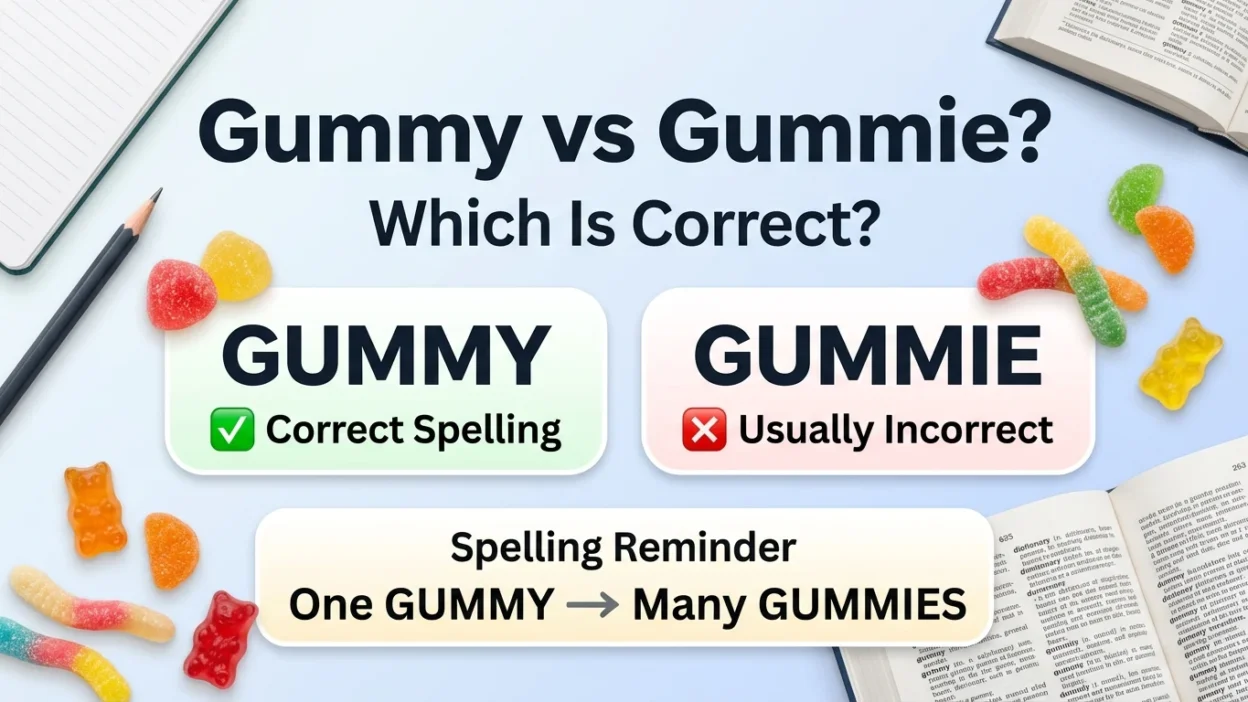
If you are wondering whether gummy or gummie is correct, the standard English spelling is gummy. Gummie is generally not the standard spelling when you mean something soft, sticky, chewy, or a type of chewy candy. Cambridge Dictionary lists gummy as an adjective and also as a noun for a small chewy sweet. (Cambridge Dictionary)
This confusion often happens because the plural of gummy is gummies, so it is easy to mistakenly think that the singular form should be gummie. However, the correct pattern is one gummy → two gummies. The spelling gummie may still appear as a name, username, brand style, or other intentional spelling, but it is not the normal standard form of the English word. This guide explains the difference clearly and shows you exactly when to use each form.
Quick Answer
Gummy is the correct standard English spelling. It can describe something soft, sticky, or chewy, and it can also refer to a small chewy candy. Gummie is generally a nonstandard spelling when used as the ordinary English word. For the plural of the candy noun, use gummies, not gummie.
Why Do People Confuse It?
The confusion between gummy and gummie usually comes from English plural spelling patterns.
Many English words ending in consonant + y change the y to ies when they become plural:
- baby → babies
- city → cities
- story → stories
Because gummy becomes gummies, some people mistakenly assume that gummie must be the singular form.
But the correct pattern is:
gummy → gummies
Not:
gummie → gummies
Pronunciation can add to the confusion because gummy is pronounced /ˈɡʌm.i/ in both British and American English. (Cambridge Dictionary)
First Word: Gummy
Gummy is the standard English spelling.
It can be used as an adjective and, in some contexts, as a noun.
Gummy as an Adjective
As an adjective, gummy can describe something that is soft, sticky, chewy, or resembles gum.
For example:
- The candy has a gummy texture.
- The rice became gummy.
- The label feels gummy.
- The dessert was soft and gummy.
Cambridge Dictionary also uses gummy for something that shows the gums, as in a gummy smile. (Cambridge Dictionary)
Gummy as a Noun
In American English, gummy can also be a noun referring to a small chewy candy. Cambridge lists this noun usage, typically in the plural gummies. (Cambridge Dictionary)
For example:
- I ate one gummy.
- She bought a bag of gummies.
- My favorite candy is gummy bears.
Second Word: Gummie
Gummie is generally not the standard spelling of the ordinary English word gummy.
For normal writing, use gummy instead.
Incorrect:
I bought a gummie bear. ❌
Correct:
I bought a gummy bear. ✅
Incorrect:
The candy is very gummie. ❌
Correct:
The candy is very gummy. ✅
However, Gummie could appear intentionally as a proper name, username, nickname, character name, or brand name. In that situation, the spelling is part of the specific name rather than the standard English spelling.
Gummy vs Gummie Comparison Table
| Feature | Gummy | Gummie |
|---|---|---|
| Standard English spelling | ✅ Yes | ❌ Generally no |
| Common dictionary word | ✅ Yes | Not the standard form |
| Means soft or chewy | ✅ Yes | ❌ No |
| Used for chewy candy | ✅ Yes | ❌ Usually incorrect |
| Used in formal writing | ✅ Yes | ❌ Avoid |
| Plural form | Gummies | — |
| Can appear as a name or brand | Yes | Yes, if intentionally styled |
When to Use Each
Use Gummy in Standard English
Use gummy when describing something soft, sticky, chewy, or gum-like.
Example:
The candy has a gummy texture.
Use Gummy for Chewy Candy
Use gummy when talking about gummy bears, gummy worms, gummy candies, and similar sweets.
Example:
The children enjoyed gummy bears.
Use Gummy for a Gummy Smile
Gummy can also describe a smile in which the gums are prominently visible.
Example:
The baby gave her a gummy smile.
This is a recognized dictionary use of the word. (Cambridge Dictionary)
Use Gummies for More Than One Candy
When referring to multiple gummy candies, use gummies.
Example:
I bought three gummies.
Avoid Gummie in Ordinary Writing
If you simply mean the standard English word, gummie should normally be replaced with gummy.
10+ Examples of Gummy
- I bought a gummy bear from the store.
- These candies have a soft, gummy texture.
- She loves gummy worms.
- The rice became too gummy after cooking.
- He ate one orange gummy.
- The children shared a bag of gummies.
- The old adhesive became gummy.
- The label left a gummy residue.
- She gave the baby a gummy smile.
- These sweets are soft and gummy.
- I prefer fruit gummies to hard candy.
- The dessert became slightly gummy after cooling.
Gummy vs Gummie in Sentences
Gummy:
I bought some gummy candy. ✅
Gummie:
I bought some gummie candy. ❌
Gummy:
This medicine comes in a gummy form. ✅
Gummie:
This medicine comes in a gummie form. ❌
Gummies:
She bought several gummies. ✅
Common Mistakes
Mistake 1: Using Gummie as the Singular
A common mistake is writing gummie because the plural is gummies.
Remember:
- One gummy ✅
- Two gummies ✅
- One gummie ❌
Mistake 2: Writing Gummie Candy
The standard phrase is:
gummy candy ✅
Not:
gummie candy ❌
Mistake 3: Confusing Gummy and Gummies
These forms have different grammatical uses.
Gummy can be an adjective or singular noun.
Gummies is the plural noun when referring to multiple chewy candies.
Examples:
- This is a gummy.
- These are gummies.
- I like gummy candy.
Mistake 4: Assuming Every Y Becomes IE
The spelling -ie is not automatically used for singular forms simply because a word has a plural ending in -ies.
For gummy, the correct relationship is:
gummy → gummies
Memory Trick
The easiest way to remember the spelling is:
One gummy, many gummies.
Think of it as:
GUMMY → GUMMIES
The y changes to ies only when forming the plural noun.
So do not write:
gummie ❌
Instead, remember:
gummy = singular
gummies = plural
This simple pattern makes the spelling much easier to remember.
American vs British English
Gummy is used in both American and British English, with the same spelling. Cambridge gives the same pronunciation for both varieties. (Cambridge Dictionary)
There can be differences in the surrounding vocabulary.
In American English, you may commonly see:
gummy candy
In British English, you may commonly see:
gummy sweets
But the spelling of gummy itself does not change to gummie.
| English Variety | Standard Spelling |
|---|---|
| American English | gummy |
| British English | gummy |
| Canadian English | gummy |
| General international English | gummy |
Similar Words
Chewy
Chewy describes food that requires a lot of chewing.
Example:
The candy is soft and chewy.
Sticky
Sticky means something adheres easily to another surface.
Example:
The syrup is very sticky.
Gooey
Gooey describes something soft, wet, and somewhat sticky.
Example:
The melted chocolate was warm and gooey.
Gluey
Gluey means sticky or resembling glue.
Example:
The mixture became thick and gluey.
Gummies
Gummies is the plural form of gummy when referring to multiple gummy candies.
Example:
She bought a packet of fruit gummies.
Final Verdict
When choosing between gummy or gummie, use gummy in standard English.
Gummy is a recognized English word used as an adjective for something soft, sticky, chewy, or gum-like. It can also be a noun referring to a small chewy candy. (Cambridge Dictionary)
Gummie is generally not the standard spelling for these meanings. It may appear as a deliberately created name, username, or brand spelling, but ordinary English writing should use gummy.
The most useful rule is simple:
One gummy → many gummies
FAQs
Is gummy or gummie correct?
Gummy is the standard English spelling. Gummie is generally not the standard spelling when you mean the ordinary word.
Is gummie a real word?
Gummie is not the standard spelling of the common English word gummy. It may appear as a proper name, brand, nickname, or intentional creative spelling.
What is the plural of gummy?
The plural is gummies when referring to multiple gummy candies.
Example: I bought five gummies.
Is it gummy candy or gummie candy?
The standard expression is gummy candy.
Gummie candy is generally a spelling mistake.
Why do people spell gummy as gummie?
The confusion often comes from plural spelling. Since gummy becomes gummies, some people mistakenly think the singular form is gummie.
Is gummy used in both American and British English?
Yes. Gummy is used in both American and British English, although the surrounding terminology can sometimes differ. (Cambridge Dictionary)
What does gummy mean?
Gummy can mean soft, sticky, chewy, or resembling gum. It can also refer to a type of chewy candy. (Cambridge Dictionary)
How do you remember gummy vs gummie?
Remember:
One gummy, many gummies.
The singular is gummy, and the plural is gummies.
Remember This
Gummy ✅
Gummie ❌
For multiple gummy candies:
Gummies ✅
The easiest rule is:
gummy → gummies
Use gummy in standard English writing unless Gummie is intentionally part of a specific name or brand.
Conclusion
The difference between gummy and gummie is simple once you understand the spelling pattern. Gummy is the standard English form used to describe something soft, sticky, chewy, or gum-like. It is also used for certain chewy candies. Gummies is the correct plural form when talking about more than one gummy candy. (Cambridge Dictionary)
Although gummie may appear online or in names and branding, it should not normally replace gummy in standard English. If you are writing an essay, article, product description, message, or school assignment, choose gummy. When you need the plural, use gummies. The simple phrase one gummy, many gummies is all you need to remember.

Gabriel John is a language enthusiast and grammar writer at Synolexes. He creates clear, practical content on English grammar, vocabulary, and writing, helping learners improve communication skills with confidence.