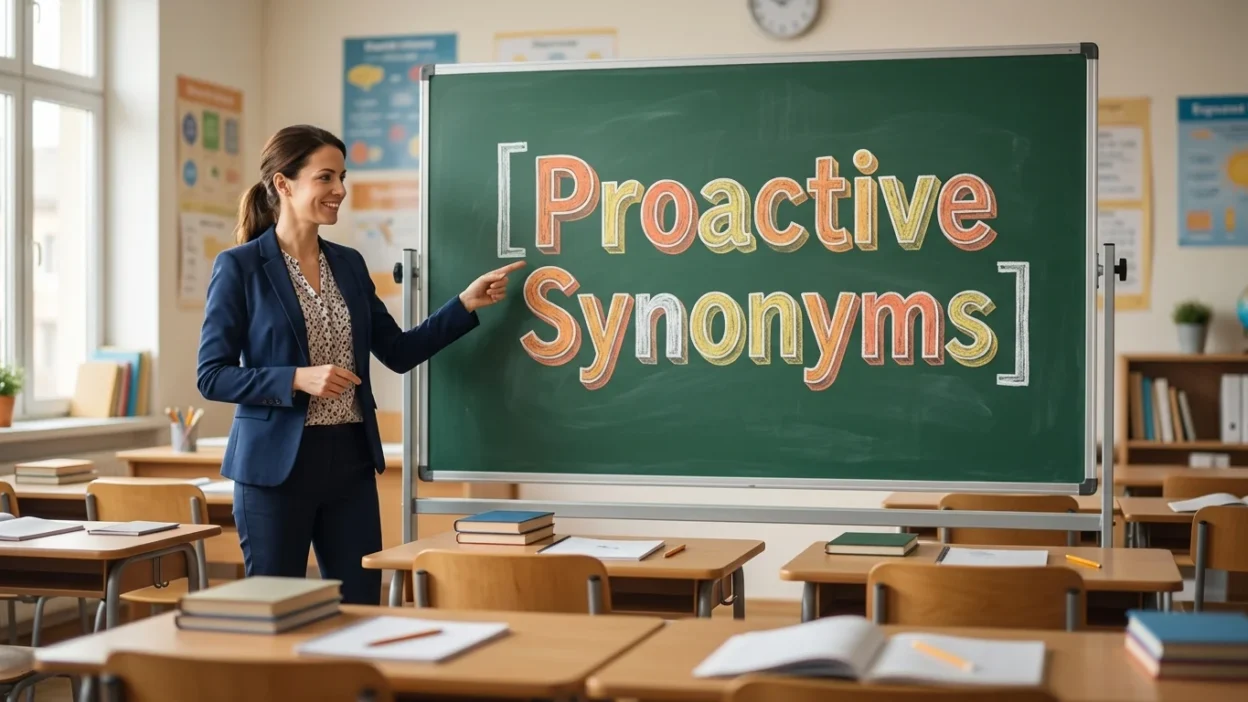
The word proactive describes someone who takes action before a problem happens instead of waiting for the problem to appear. It is commonly used for people, teams, businesses, plans, and strategies that anticipate needs and act early.
Understanding proactive synonyms can help students, ESL learners, writers, and content creators choose more precise vocabulary. Words such as preventive, anticipatory, forward-thinking, and initiative-taking are related to proactive behavior, but each one focuses on a slightly different quality.
Using the right synonym can make your writing more effective. For example, preventive emphasizes stopping a problem, prepared emphasizes readiness, and forward-thinking emphasizes planning for the future. This guide explains these differences in simple English.
What Does Proactive Mean?
Simple Meaning of Proactive
Proactive means taking action early to prevent problems, prepare for the future, or create positive results.
For example:
She is proactive about her health and plans regular checkups.
This means she does not simply wait for problems. She takes action in advance.
A proactive employee might identify a problem and solve it before it becomes serious.
Tone and Usage of Proactive
The word proactive usually has a positive and professional tone. It is common in:
- business
- education
- leadership
- management
- personal development
- customer service
- planning
- problem-solving
It often suggests initiative, responsibility, preparation, and future-focused thinking.
30 Proactive Synonyms
1. Preventive
Meaning: Intended to stop a problem before it happens.
Example sentence: The company introduced preventive measures to reduce workplace accidents.
Best usage context: Excellent for health, safety, business, and risk management.
2. Anticipatory
Meaning: Done in preparation for something expected to happen.
Example sentence: The team took anticipatory action before demand increased.
Best usage context: Formal and professional writing.
3. Forward-Thinking
Meaning: Considering future needs and possibilities.
Example sentence: The company needs a forward-thinking leader who understands emerging trends.
Best usage context: Business, leadership, technology, and strategy.
4. Initiative-Taking
Meaning: Willing to act without waiting for someone else to give instructions.
Example sentence: Her initiative-taking attitude made her a valuable member of the team.
Best usage context: Workplace, education, and leadership contexts.
5. Prepared
Meaning: Ready for a situation before it happens.
Example sentence: The emergency team was prepared for possible delays.
Best usage context: General English and practical situations.
6. Preemptive
Meaning: Done in advance to prevent an expected problem or action.
Example sentence: The company took preemptive action to protect its systems.
Best usage context: Business, security, strategy, and formal writing.
7. Precautionary
Meaning: Done to prevent possible danger or problems.
Example sentence: Workers took precautionary steps before entering the damaged building.
Best usage context: Safety, health, science, and technical writing.
8. Preventative
Meaning: Intended to prevent a problem from happening.
Example sentence: Preventative maintenance can reduce equipment failures.
Best usage context: Health, maintenance, safety, and everyday professional writing.
9. Enterprising
Meaning: Showing energy, confidence, and willingness to take opportunities.
Example sentence: The enterprising student started a small online business.
Best usage context: Business, entrepreneurship, careers, and personal qualities.
10. Resourceful
Meaning: Good at finding practical solutions to problems.
Example sentence: She was resourceful enough to solve the issue without additional help.
Best usage context: Work, problem-solving, leadership, and everyday situations.
11. Vigilant
Meaning: Carefully watching for possible problems or dangers.
Example sentence: The security team remained vigilant throughout the event.
Best usage context: Security, safety, risk management, and monitoring.
12. Alert
Meaning: Paying close attention and ready to respond.
Example sentence: The staff stayed alert for signs of technical problems.
Best usage context: Safety, emergencies, and everyday communication.
13. Ready
Meaning: Prepared to act or respond.
Example sentence: The team was ready to deal with unexpected changes.
Best usage context: Simple, general English.
14. Foresighted
Meaning: Able to think about future consequences and needs.
Example sentence: Her foresighted planning helped the organization avoid future problems.
Best usage context: Formal writing, leadership, planning, and strategy.
15. Anticipative
Meaning: Acting with awareness of what may happen in the future.
Example sentence: The manager took an anticipative approach to customer needs.
Best usage context: Formal or specialized writing.
16. Responsive
Meaning: Quick to react appropriately when something happens.
Example sentence: The customer service team was responsive to complaints.
Best usage context: Business, communication, and customer service.
17. Engaged
Meaning: Actively involved and paying attention to what is happening.
Example sentence: The engaged employee regularly suggests ways to improve the process.
Best usage context: Work, education, and teamwork.
18. Active
Meaning: Taking action rather than remaining passive.
Example sentence: The organization takes an active role in supporting the community.
Best usage context: General and professional writing.
19. Dynamic
Meaning: Energetic, active, and willing to change or develop.
Example sentence: The dynamic team quickly responded to changing market conditions.
Best usage context: Business, leadership, and organizational writing.
20. Industrious
Meaning: Hard-working and consistently willing to make an effort.
Example sentence: The industrious employee always looks for ways to improve efficiency.
Best usage context: Work, education, and formal descriptions of effort.
21. Diligent
Meaning: Careful, responsible, and persistent in doing work.
Example sentence: She was diligent in checking the project’s potential risks.
Best usage context: Academic, professional, and formal writing.
22. Assertive
Meaning: Confidently taking action or expressing what you need.
Example sentence: He took an assertive approach to solving the team’s problems.
Best usage context: Leadership, communication, and workplace situations.
23. Decisive
Meaning: Able and willing to make decisions quickly and confidently.
Example sentence: The decisive manager acted before the problem became worse.
Best usage context: Leadership, emergencies, and decision-making.
24. Strategic
Meaning: Carefully planned to achieve a future goal.
Example sentence: The organization adopted a strategic approach to future growth.
Best usage context: Business, planning, leadership, and management.
25. Preventative-Minded
Meaning: Focused on stopping problems before they occur.
Example sentence: A preventative-minded approach can reduce unnecessary costs.
Best usage context: Descriptive and explanatory writing.
26. Future-Oriented
Meaning: Focused on future needs, goals, and possibilities.
Example sentence: The school is developing a future-oriented curriculum.
Best usage context: Education, business, technology, and planning.
27. Solution-Oriented
Meaning: Focused on finding practical solutions instead of only discussing problems.
Example sentence: Her solution-oriented attitude helped the team move forward.
Best usage context: Business, management, teamwork, and problem-solving.
28. Action-Oriented
Meaning: Focused on taking practical action and achieving results.
Example sentence: The manager has an action-oriented approach to project management.
Best usage context: Business, leadership, productivity, and careers.
29. Constructive
Meaning: Intended to improve a situation or produce a useful result.
Example sentence: The team gave constructive suggestions before the project began.
Best usage context: Feedback, communication, teamwork, and planning.
30. Preventive-Minded
Meaning: Focused on identifying and avoiding potential problems in advance.
Example sentence: A preventive-minded employee notices risks before they become serious issues.
Best usage context: Workplace, safety, management, and risk reduction.
Proactive Synonyms Comparison Guide
Different alternatives highlight different parts of proactive behavior.
| Synonym | Main Idea | Tone | Best For |
|---|---|---|---|
| Preventive | Stops problems early | Professional | Safety, health |
| Anticipatory | Acts before expected events | Formal | Planning |
| Forward-Thinking | Focuses on the future | Positive | Leadership, strategy |
| Initiative-Taking | Acts without waiting | Positive | Work, education |
| Prepared | Ready in advance | Neutral | General use |
| Preemptive | Prevents an expected problem | Formal | Strategy, security |
| Precautionary | Reduces possible risk | Formal | Safety |
| Enterprising | Takes opportunities | Positive | Business |
| Resourceful | Finds solutions | Positive | Problem-solving |
| Vigilant | Watches for risks | Serious | Security |
| Alert | Ready to respond | Neutral | Safety |
| Foresighted | Understands future consequences | Formal | Planning |
| Responsive | Reacts quickly | Professional | Customer service |
| Engaged | Actively involved | Positive | Work, education |
| Dynamic | Energetic and adaptable | Positive | Business |
| Diligent | Careful and responsible | Positive | Work, study |
| Assertive | Acts confidently | Strong | Communication |
| Decisive | Makes timely choices | Positive | Leadership |
| Strategic | Plans for goals | Professional | Business |
| Future-Oriented | Focuses on the future | Professional | Planning |
| Solution-Oriented | Focuses on solutions | Positive | Teams, management |
| Action-Oriented | Focuses on action | Positive | Productivity |
| Constructive | Aims to improve things | Positive | Feedback, teamwork |
How to Choose the Right Synonym
When You Mean Preventing Problems
Use preventive, preventative, precautionary, preemptive, or preventive-minded when the main goal is stopping a problem before it occurs.
For example:
The company took proactive steps to avoid equipment failure.
can become:
The company took preventive steps to avoid equipment failure.
When You Mean Planning for the Future
Choose forward-thinking, foresighted, anticipatory, future-oriented, or strategic when the focus is on future needs or consequences.
When You Mean Taking Initiative
Use initiative-taking, enterprising, action-oriented, active, or assertive when someone takes action without waiting for others.
When You Mean Being Prepared
Choose prepared, ready, alert, or vigilant when someone is ready to respond to possible events.
When You Mean Solving Problems
Use resourceful, solution-oriented, constructive, or decisive when the person actively looks for solutions.
When You Mean Business Strategy
Choose strategic, forward-thinking, future-oriented, anticipatory, or foresighted for professional strategy and planning.
When You Want a Professional Tone
For workplace or academic writing, proactive, anticipatory, preventive, strategic, foresighted, and solution-oriented are strong choices.
When You Want Simple English
For ESL learners, the easiest alternatives are prepared, active, ready, alert, and preventive.
Proactive vs. Preventive
Proactive
Means taking action in advance, often to prevent problems or create positive results.
Preventive
Specifically emphasizes preventing a problem or harmful event.
A proactive strategy can be preventive, but proactive behavior can also involve taking advantage of an opportunity rather than simply avoiding a problem.
Proactive vs. Reactive
Proactive
Acts before a problem or event requires a response.
Reactive
Acts after something has already happened.
For example:
Proactive: The company identified a security weakness and fixed it.
Reactive: The company fixed the weakness after an attack occurred.
This is one of the most important distinctions when using proactive.
Proactive vs. Anticipatory
Proactive
Describes taking action in advance.
Anticipatory
More specifically emphasizes expecting something and preparing for it.
An anticipatory response is therefore usually a type of proactive response.
Proactive vs. Forward-Thinking
Proactive
Focuses on action.
Forward-Thinking
Focuses more on future possibilities and long-term planning.
A forward-thinking leader may develop ideas for future challenges, while a proactive leader actively takes steps to address current and future needs.
Proactive vs. Assertive
Proactive
Means acting early and taking initiative.
Assertive
Means expressing yourself or acting confidently and directly.
Someone can be assertive without being proactive, and proactive without being assertive.
Why Use Proactive Synonyms?
Using a more precise synonym helps explain why someone is proactive.
For example:
- Proactive employee → initiative-taking employee
- Proactive safety plan → preventive safety plan
- Proactive strategy → forward-thinking strategy
- Proactive manager → decisive manager
- Proactive problem-solving → solution-oriented problem-solving
- Proactive monitoring → vigilant monitoring
- Proactive business → future-oriented business
Each alternative gives the reader a slightly clearer picture.
Common Uses of Proactive Synonyms
In the Workplace
Use initiative-taking, diligent, solution-oriented, action-oriented, and engaged when describing employees.
In Leadership
Choose decisive, strategic, foresighted, forward-thinking, and assertive when describing leaders.
In Safety
Words such as preventive, precautionary, preemptive, and vigilant are especially useful.
In Business Strategy
Use future-oriented, anticipatory, strategic, forward-thinking, and adaptive language.
In Education
Choose initiative-taking, engaged, diligent, active, and prepared for students and educators.
In Problem-Solving
Use resourceful, solution-oriented, constructive, and decisive when discussing practical action.
FAQs
What is the closest synonym for proactive?
Initiative-taking, anticipatory, preventive, and forward-thinking are among the closest alternatives, depending on context.
What is a simple synonym for proactive?
Active, prepared, or initiative-taking can be simple alternatives.
What is a formal synonym for proactive?
Anticipatory, preventive, preemptive, strategic, and foresighted can work well in formal writing.
Is preventive the same as proactive?
Not exactly. Preventive focuses specifically on avoiding problems, while proactive can include prevention, preparation, improvement, or opportunity-seeking.
Is proactive the opposite of reactive?
They are commonly presented as contrasting approaches. Proactive action happens in advance, while reactive action responds after an event or problem occurs.
Is forward-thinking the same as proactive?
They are closely related, but forward-thinking emphasizes future ideas and planning, while proactive emphasizes taking action.
What is a positive synonym for proactive?
Forward-thinking, resourceful, enterprising, solution-oriented, and initiative-taking are generally positive.
What is the opposite of proactive?
The most common contrasting terms are reactive, passive, unprepared, and inactive, depending on the context.
Conclusion
Understanding proactive synonyms gives you more precise ways to describe initiative, preparation, prevention, future planning, and action. Although proactive is a broad and useful word, different alternatives highlight different qualities.
Use preventive when the goal is to stop problems, anticipatory when action is based on expectations, and forward-thinking when the focus is on the future. Choose initiative-taking when someone acts without waiting, resourceful when they solve problems creatively, and strategic when actions are connected to long-term goals.
For professional writing, foresighted, preventive, anticipatory, strategic, and solution-oriented are strong choices. For simple English, active, prepared, ready, and alert are easier alternatives.
The best synonym depends on what you want to emphasize: prevention, preparation, initiative, problem-solving, or future planning. Choosing the right word can make your writing clearer, more natural, and more effective.

Gabriel John is a language enthusiast and grammar writer at Synolexes. He creates clear, practical content on English grammar, vocabulary, and writing, helping learners improve communication skills with confidence.