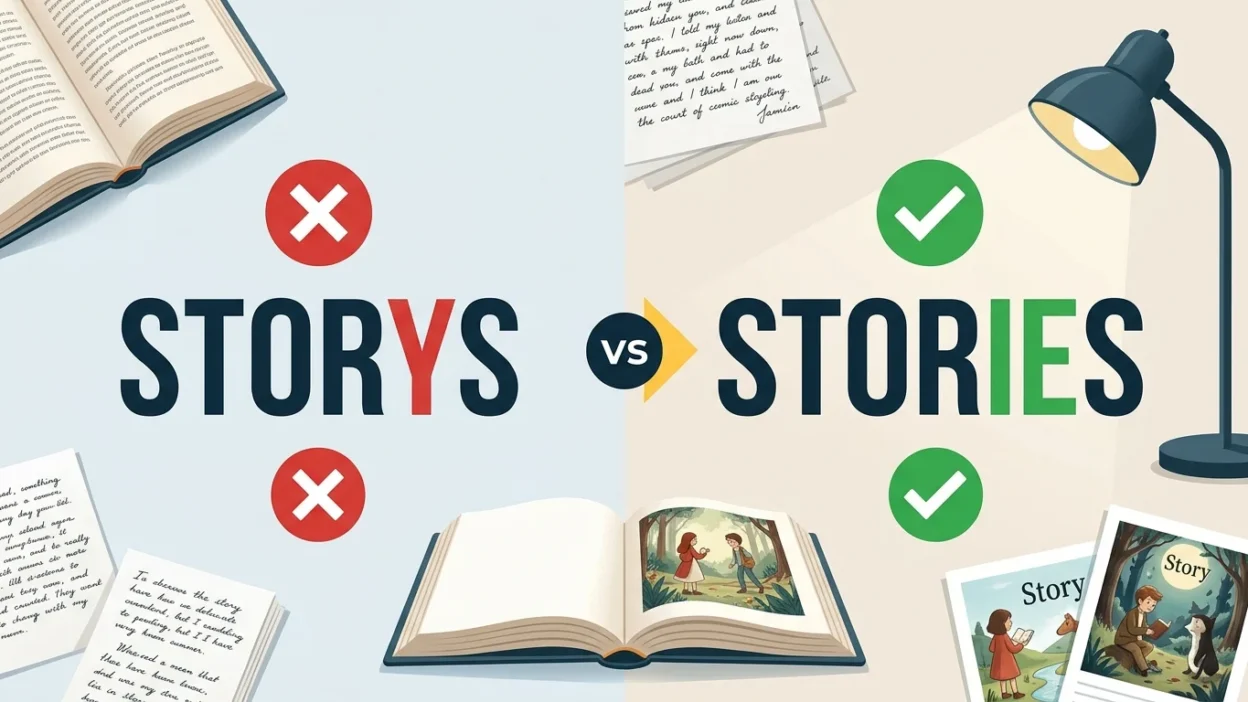
If you are wondering whether storys or stories is the correct spelling, the answer is stories. Storys is generally an incorrect spelling in standard English.
The word stories is the plural form of story, meaning more than one story. The spelling changes from story to stories because nouns ending in a consonant followed by y usually change the y to ies when they become plural.
Understanding this simple rule can help you avoid a common spelling mistake and improve your everyday English writing.
Quick Answer
Stories is the correct plural spelling of story. Use stories when referring to two or more stories. Storys is incorrect in standard English. Remember the spelling rule: story → stories, just like city → cities and family → families.
Why People Confuse It
The confusion usually happens because many English nouns form their plurals by simply adding s.
For example:
- book → books
- car → cars
- table → tables
- story → stories
However, words ending in a consonant + y normally follow a different pattern.
The final y changes to ie, and then s is added.
So:
story → stories
Not:
story → storys
This spelling pattern appears in many common English words.
First Word: Storys
Storys is generally an incorrect spelling in standard English.
It is often created by adding s directly to the singular word story. However, because story ends with a consonant followed by y, its plural form changes the y to ie.
Incorrect:
- I read three storys yesterday.
- The book contains many interesting storys.
- She writes short storys for children.
Correct:
- I read three stories yesterday.
- The book contains many interesting stories.
- She writes short stories for children.
If you see storys in standard English writing, it should generally be corrected to stories.
Second Word: Stories
Stories is the correct plural form of story.
A story can mean a narrative about real or imaginary events. It can also refer to a personal account, news report, or tale.
When there is more than one story, use stories.
Examples:
- I enjoy reading short stories.
- The children listened to several stories.
- These stories teach important lessons.
- She shared interesting stories about her travels.
The spelling follows this pattern:
story → stories
Comparison Table
| Word | Correct? | Meaning | Example |
|---|---|---|---|
| storys | ❌ No | Incorrect plural spelling | She writes short storys. |
| stories | ✅ Yes | More than one story | She writes short stories. |
| story | ✅ Yes | One narrative or account | I read a story. |
When to Use Each
Use Story for One
Use story when you are talking about one narrative, account, or tale.
Examples:
- I read a story before bed.
- This story is very interesting.
- He told me a funny story.
- She wrote a short story.
Use Stories for More Than One
Use stories when referring to two or more narratives or accounts.
Examples:
- I love reading stories.
- The teacher told us several stories.
- These stories are easy to understand.
- She collects stories from different cultures.
Do Not Use Storys
In standard English, do not use storys as the plural of story.
The correct form is always:
stories
12 Examples of Stories in Sentences
- Children often enjoy listening to stories before bedtime.
- The book contains several interesting stories.
- She writes short stories in her free time.
- These stories have meaningful lessons.
- I enjoy reading historical stories.
- The teacher asked the students to write their own stories.
- Many traditional stories are passed from one generation to another.
- He told us funny stories about his childhood.
- The newspaper published several stories about the event.
- Different cultures have unique stories and traditions.
- We read three stories during the English lesson.
- Her collection includes both fictional and true stories.
Common Mistakes
Mistake 1: Adding S Directly
A common mistake is simply adding s to story.
Incorrect:
storys
Correct:
stories
Mistake 2: Forgetting the Y-to-IES Rule
Because story ends in a consonant + y, the y changes to ie in the plural.
Therefore:
story → stories
Mistake 3: Confusing Story With Words Ending in a Vowel + Y
Not every word ending in y changes to ies.
For example:
- boy → boys
- toy → toys
- day → days
- key → keys
These words have a vowel before the y, so they normally take s.
Compare:
- story → stories
- boy → boys
This difference is important when forming plurals correctly.
Memory Trick
Remember:
Consonant + Y → IES
So:
STORY → STORIES
Think of the phrase:
One story, many stories.
You can also remember similar examples:
- city → cities
- family → families
- baby → babies
- party → parties
- country → countries
The pattern becomes easier once you recognize it in several common words.
American vs British English
There is no spelling difference between American and British English for this word.
Both use:
story — singular
stories — plural
Examples:
- American English: I enjoy reading stories.
- British English: I enjoy reading stories.
The spelling stories is standard in both varieties.
Similar Words
Several common English words follow the same plural spelling pattern.
City → Cities
One city becomes two or more cities.
Family → Families
One family becomes several families.
Baby → Babies
One baby becomes several babies.
Party → Parties
One party becomes several parties.
Country → Countries
One country becomes several countries.
These examples all demonstrate the basic consonant + y → ies rule.
However, remember that words ending in a vowel + y usually keep the y and simply add s:
- boy → boys
- toy → toys
- day → days
- key → keys
Final Verdict
The correct spelling is stories.
Storys is generally incorrect in standard English.
Use:
story for one narrative.
stories for two or more narratives.
The key spelling change is:
story → stories
FAQs
Is storys a correct spelling?
No. Storys is generally incorrect in standard English. The correct plural spelling is stories.
Is stories the plural of story?
Yes. Stories is the standard plural form of story.
Why does story become stories?
Because story ends in a consonant followed by y. When it becomes plural, the y changes to ie, and s is added.
What is the plural of story?
The plural of story is stories.
Is it storys or stories?
The correct spelling is stories. Storys is a common spelling mistake.
Do you change y to ies in stories?
Yes. The spelling changes from story to stories by replacing the final y with ies.
What are words similar to story and stories?
Examples include city → cities, family → families, baby → babies, and party → parties.
Do American and British English spell stories differently?
No. Both American and British English use stories.
Remember This
The easiest rule to remember is:
One story → many stories
Not:
storys ❌
But:
stories ✅
Remember the pattern:
Consonant + Y → IES
So:
story → stories
Conclusion
The difference between storys and stories is a simple spelling issue. Stories is the correct standard English plural of story, while storys is generally a misspelling. The word changes its final y to ie before the plural s is added.
Whenever you are talking about more than one narrative, tale, account, or written story, use stories. Learning the pattern story → stories also helps with other words such as city → cities, family → families, and country → countries.

Julian Luke is a passionate grammar and language writer at Synolexes. He simplifies complex grammar rules, vocabulary, and writing concepts, helping learners improve their English communication skills with confidence.