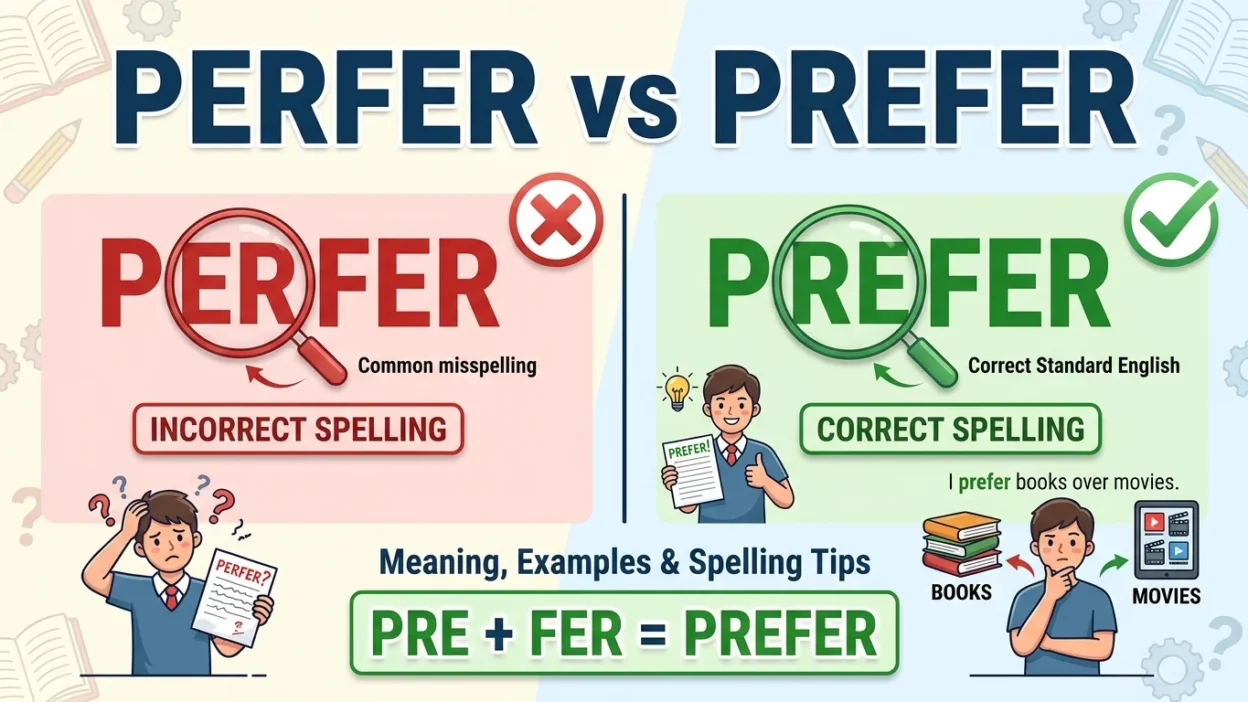
The words perfer vs prefer are easy to confuse because they differ by only one letter. However, only prefer is the standard spelling in modern English. The word perfer is a common spelling mistake and should generally be avoided in school assignments, emails, essays, and professional writing.
The verb prefer means to like or choose one thing more than another. For example, you might prefer tea to coffee, prefer reading to watching television, or prefer working in the morning rather than at night. It is a useful word for expressing choices, opinions, and personal preferences in everyday conversations. Learning the correct spelling will help you communicate more clearly and avoid common writing errors. In this guide, you will learn the meanings of both forms, see the correct spelling in practical sentences, compare similar words, and discover simple tricks for remembering prefer.
Quick Answer
Prefer is the correct spelling, while perfer is a misspelling. Prefer is a verb that means to like, want, or choose one thing more than another. For example, I prefer tea to coffee. Use prefer in standard English writing, speaking, and formal communication.
Why Do People Confuse Perfer and Prefer?
People often confuse perfer and prefer because the words look similar, and the difference is easy to overlook when typing quickly.
The correct spelling contains the letters P-R-E-F-E-R. Some writers accidentally switch the first e and r after the initial P, producing perfer.
Common reasons for this mistake include:
- Typing too quickly without checking spelling.
- Remembering the pronunciation but not the exact letter order.
- Making a typing error on a keyboard or phone.
- Learning English spelling patterns that are difficult to remember.
- Relying on autocorrect without reviewing the final text.
The easiest solution is to remember that prefer begins with pre-, as in preference and preferable.
1. Perfer: Meaning and Usage
Perfer is a misspelling of prefer in standard modern English. It is not the correct form to use when expressing a choice or personal preference.
You may encounter perfer in online comments, informal messages, or writing that contains spelling errors. However, it should not be used as a substitute for prefer in standard English.
Examples of the Incorrect Spelling
The following sentences show the spelling mistake and its correction.
1. Incorrect: I perfer tea over coffee. Correct: I prefer tea over coffee.
2. Incorrect: They perfer to travel by train. Correct: They prefer to travel by train.
3. Incorrect: She would perfer to stay home. Correct: She would prefer to stay home.
4. Incorrect: We perfer working in the morning. Correct: We prefer working in the morning.
5. Incorrect: He perfer reading books. Correct: He prefers reading books.
Usage tip: If you mean to express a choice or say what someone likes better, write prefer.
2. Prefer: Meaning and Usage
Prefer is a verb that means to like or choose one thing more than another. It helps you express your personal choices, opinions, and habits.
You can use prefer when discussing food, activities, transportation, working arrangements, entertainment, or almost any other choice.
Examples of Prefer
- I prefer tea to coffee.
- She prefers reading books to watching television.
- We prefer to travel by train.
- He would prefer to stay at home tonight.
- They prefer working in a quiet environment.
- I prefer summer because the days are longer.
- My parents prefer homemade meals.
- Do you prefer coffee or tea?
- She prefers walking to driving short distances.
- I would prefer to discuss this matter tomorrow.
- Many students prefer studying in the morning.
- He prefers simple explanations over complicated ones.
Common Grammar Patterns With Prefer
The word prefer appears in several useful sentence patterns.
- Prefer A to B: I prefer tea to coffee.
- Prefer doing A to doing B: She prefers walking to running.
- Prefer to do something: I prefer to study alone.
- Would prefer to do something: We would prefer to leave early.
Remember that the usual comparison pattern is prefer A to B, not prefer A than B.
Perfer vs Prefer: Comparison Table
| Feature | Perfer | Prefer |
|---|---|---|
| Spelling status | Incorrect spelling | Correct spelling |
| Part of speech | Not standard as intended here | Verb |
| Meaning | No standard meaning in this context | To like or choose one thing more |
| Standard English usage | Avoid | Use |
| Suitable for formal writing | No | Yes |
| Example | I perfer tea. | I prefer tea. |
| Related word | — | Preference |
When Should You Use Perfer or Prefer?
The choice is straightforward because only one spelling is correct for the intended meaning.
Use Prefer When
- Expressing a personal choice.
- Comparing two foods, activities, or places.
- Explaining how you like to work or study.
- Writing emails, essays, reports, or messages.
- Talking about what another person would like better.
Examples:
- I prefer studying in the library.
- She would prefer to arrive early.
- They prefer tea to coffee.
Avoid Perfer When
- Writing school assignments.
- Creating professional documents.
- Publishing blog posts or articles.
- Sending formal emails.
- Taking English spelling or grammar tests.
Instead of writing I perfer this option, write I prefer this option.
15 Examples of Perfer vs Prefer in Sentences
Here are practical examples to help you recognize the correct spelling.
1. Incorrect: I perfer cold water. Correct: I prefer cold water.
2. Incorrect: She perfer chocolate ice cream. Correct: She prefers chocolate ice cream.
3. Incorrect: We perfer to leave early. Correct: We prefer to leave early.
4. Incorrect: He would perfer a different seat. Correct: He would prefer a different seat.
5. Incorrect: They perfer online classes. Correct: They prefer online classes.
6. Incorrect: I perfer reading novels. Correct: I prefer reading novels.
7. Incorrect: My brother perfer football. Correct: My brother prefers football.
8. Incorrect: Do you perfer tea or coffee? Correct: Do you prefer tea or coffee?
9. Incorrect: I perfer working alone. Correct: I prefer working alone.
10. Incorrect: She would perfer to speak privately. Correct: She would prefer to speak privately.
11. Incorrect: We perfer quiet places. Correct: We prefer quiet places.
12. Incorrect: He perfer to walk to school. Correct: He prefers to walk to school.
13. Incorrect: Most people perfer comfortable clothes. Correct: Most people prefer comfortable clothes.
14. Incorrect: I perfer this design over the other one. Correct: I prefer this design over the other one.
15. Incorrect: They would perfer to wait until tomorrow. Correct: They would prefer to wait until tomorrow.
These examples show that the correct spelling remains prefer. The verb changes to prefers when the subject is he, she, or it in the simple present tense.
Common Mistakes When Using Perfer and Prefer
1. Reversing the Letters
Incorrect: I perfer apples.
Correct: I prefer apples.
Remember the spelling sequence: P-R-E-F-E-R.
2. Forgetting the Third-Person S
Incorrect: She prefer tea.
Correct: She prefers tea.
Use prefers with he, she, and it in the simple present tense.
3. Using Than Instead of To
Less standard in the usual comparison pattern: I prefer tea than coffee.
Correct: I prefer tea to coffee.
4. Confusing Prefer With Preference
Prefer is a verb, while preference is a noun.
- Verb: I prefer tea.
- Noun: My preference is tea.
5. Forgetting the Correct Spelling in Formal Writing
A spelling mistake can distract readers from your message. Review your writing before submitting an assignment or sending a professional email.
Memory Trick: How to Remember Prefer
Use this simple trick:
PRE + FER = PREFER
Remember the first three letters as PRE, just like the beginning of preference and preferable.
You can also memorize this sentence:
I prefer the correct spelling, P-R-E-F-E-R.
Whenever you are unsure, think of the related word preference. Both words begin with pre-, which can help you remember the correct spelling.
American vs British English
There is no spelling difference between American and British English for this word.
Both varieties use prefer as the correct spelling. The word has the same basic meaning and follows the same common grammar patterns.
| English variety | Correct spelling | Example |
|---|---|---|
| American English | Prefer | I prefer coffee. |
| British English | Prefer | I prefer tea. |
| American English | Preference | My preference is coffee. |
| British English | Preference | My preference is tea. |
Whether you are writing for an American, British, or international audience, use prefer.
Similar Words to Prefer
Several English words are related to prefer, but each has a slightly different meaning.
- Preference: A greater liking for one thing over another. Example: My preference is green tea.
- Preferable: More suitable or desirable. Example: An earlier appointment would be preferable.
- Choose: To select one option. Example: I choose the blue shirt.
- Favor: To like, support, or show a preference for something. Example: She favors simple designs.
- Like: To enjoy or feel positively about something. Example: I like classical music.
- Rather: Used to express a choice or alternative. Example: I would rather stay home.
- Opt for: To choose a particular option. Example: We opted for the cheaper plan.
These words can express choices, but they are not always interchangeable. Prefer is especially useful when comparing two or more options.
Final Verdict: Perfer or Prefer?
Prefer is the correct spelling. Perfer is a misspelling and should be avoided in standard English.
Use prefer when you want to express that you like or choose one thing more than another. Remember its related forms, including prefers, preferred, preferring, and preference, because they are useful in everyday writing.
The simplest way to remember the difference is to focus on the beginning: prefer starts with PRE, not PER.
FAQs
1. Is it perfer or prefer?
Prefer is correct. Perfer is a misspelling of the verb used to express a choice or liking.
2. What does prefer mean?
Prefer means to like or choose one thing more than another. For example, I prefer tea to coffee.
3. Why do people spell prefer as perfer?
People may reverse letters while typing or misremember the spelling. The correct sequence is P-R-E-F-E-R.
4. Is perfer ever correct in English?
For the intended meaning of liking or choosing one thing over another, perfer is not the standard spelling. Use prefer.
5. What is the past tense of prefer?
The past tense is preferred. For example: I preferred the earlier version.
6. What is the noun form of prefer?
The noun is preference. For example: My preference is to study in the morning.
7. Is prefer spelled differently in American and British English?
No. Both American and British English use prefer.
Remember This
- Prefer is correct.
- Perfer is a misspelling.
- Prefer means to like or choose one thing more than another.
- The past tense is preferred.
- The noun form is preference.
- Remember: PRE + FER = PREFER.
Conclusion
The difference between perfer and prefer is simple: prefer is the correct spelling, while perfer is a common spelling mistake. The word prefer helps you express choices, compare options, and explain what you like better in everyday conversations and formal writing.
To avoid this error, remember the letters P-R-E-F-E-R and connect the word with preference. With a little practice, you can use prefer confidently in essays, emails, online posts, and daily communication.

Gabriel John is a language enthusiast and grammar writer at Synolexes. He creates clear, practical content on English grammar, vocabulary, and writing, helping learners improve communication skills with confidence.