
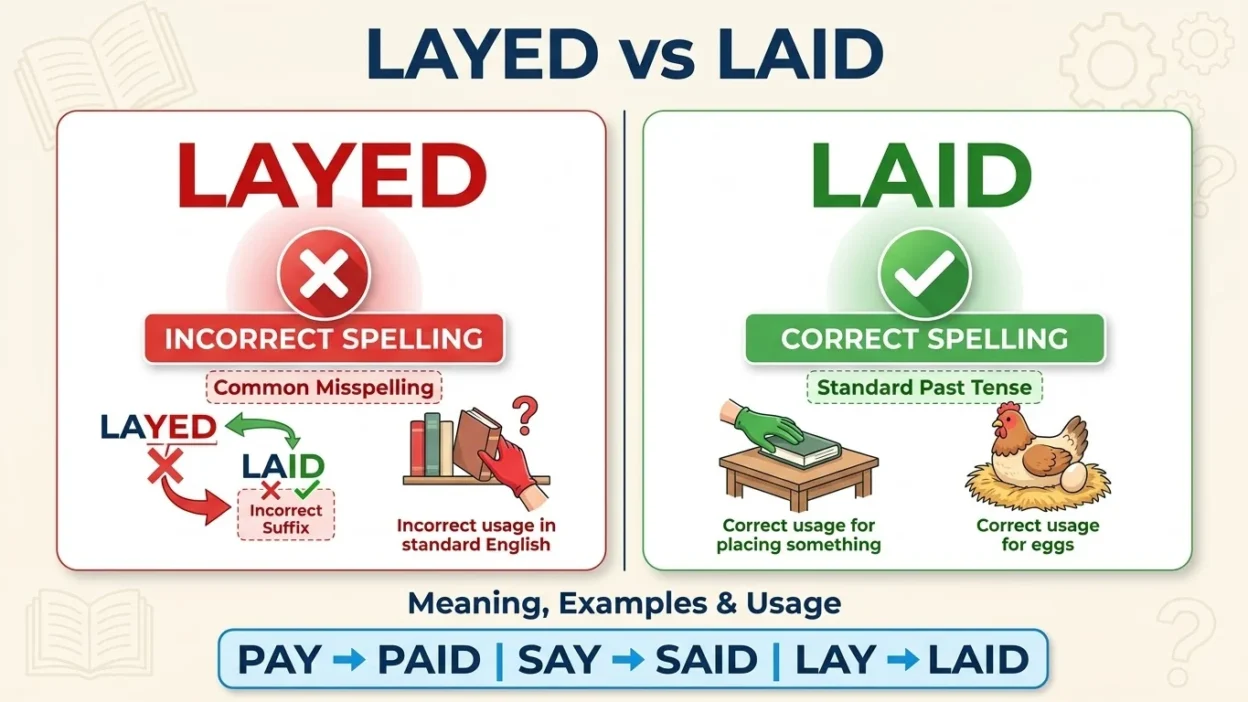
The words layed vs laid are often confused because they look similar and seem to follow the same spelling pattern. However, laid is the standard past tense and past participle of the verb lay. In modern standard English, layed is generally considered a misspelling when used as the past tense of lay.
Understanding the difference between layed and laid can help you improve your spelling, write more naturally, and avoid common grammar mistakes. These words can be especially confusing because English verbs do not always form their past tense by simply adding -ed. For example, we write played from play, but the past tense of lay is laid.
Quick Answer: Layed vs Laid
Laid is the correct spelling when you mean that someone placed or put something down. It is the past tense and past participle of lay. Layed is not the standard spelling in modern English for this meaning. For example, She laid the book on the table is correct, while She layed the book on the table is incorrect.
Why Do People Confuse Layed and Laid?
People often confuse these spellings because many English verbs form their past tense by adding -ed. For example:
- Play → Played
- Walk → Walked
- Clean → Cleaned
- Lay → Laid
The verb lay is irregular, which means its past tense does not follow the usual -ed pattern. This makes laid less predictable for English learners and beginners.
Another reason for the confusion is that laid is pronounced like the word made, while layed may look like a logical spelling to someone who has not learned the irregular form.
What Does Laid Mean?
Laid is the past tense and past participle of the verb lay, which means to put, place, or set something down. The verb lay normally takes a direct object.
Examples:
- She laid the keys beside the door.
- He laid his jacket on the chair.
- They laid the foundation for a new building.
- The hen has laid three eggs.
In each sentence, laid describes an action involving something being placed or produced.
Example Sentences with Laid
- She laid her phone on the desk.
- He laid the baby gently in the crib.
- They laid the books on the shelf.
- The workers laid the bricks carefully.
- I laid my bag beside the sofa.
- The hen laid an egg this morning.
- She laid the documents in a folder.
- He laid a blanket on the grass.
- We laid the table before dinner.
- The team laid the groundwork for the project.
What Does Layed Mean?
Layed is generally a nonstandard spelling of laid when referring to the past tense of lay. In ordinary modern English writing, you should use laid instead.
Incorrect: He layed the blanket on the bed.
Correct: He laid the blanket on the bed.
Although you may occasionally encounter layed in older, regional, informal, or specialized texts, it is not the accepted standard spelling for the usual meaning of placing something down. For schoolwork, professional writing, and everyday communication, choose laid.
Layed vs Laid: Comparison Table
| Feature | Layed | Laid |
|---|---|---|
| Standard spelling | No, for the usual past tense of lay | Yes |
| Meaning | Intended as the past tense of lay | Placed or put something down |
| Grammar | Nonstandard in this use | Past tense and past participle |
| Example | She layed the book down. | She laid the book down. |
| Recommended use | Avoid in standard writing | Use this spelling |
When Should You Use Laid?
Use laid when describing an action that happened in the past or when using the past participle of lay.
1. When Someone Placed Something Down
- He laid the letter on my desk.
- She laid her coat on the sofa.
2. When Describing Construction or Preparation
- The workers laid the new road.
- The company laid the groundwork for expansion.
3. When Talking About Eggs
- The hen laid an egg yesterday.
- The bird has laid its eggs in the nest.
4. When Using the Present Perfect Tense
Use has laid, have laid, or had laid when the sentence requires a past participle.
- She has laid the papers on the table.
- They had laid the foundation before winter.
What Is the Difference Between Lay, Laid, and Lain?
These three forms are related, but they are used differently.
| Word | Usage | Example |
|---|---|---|
| Lay | Present tense; usually requires an object | I lay the book on the desk. |
| Laid | Past tense and past participle of lay | I laid the book on the desk. |
| Lain | Past participle of lie, meaning to recline | I have lain in bed all morning. |
A common source of confusion is the difference between lay and lie.
- Lay means to put something down: I lay the keys on the table.
- Lie means to recline: I lie on the bed.
Their forms differ:
- Lay → laid → laid
- Lie → lay → lain
For this reason, the sentence I laid down for a nap is often heard in casual speech, but in standard usage, I lay down for a nap is the simple past of lie.
15 Examples of Layed vs Laid
Here are examples that show the correct spelling in common situations.
| Incorrect or nonstandard | Correct |
|---|---|
| She layed the book on the desk. | She laid the book on the desk. |
| He layed his phone beside the bed. | He laid his phone beside the bed. |
| They layed the bricks in a straight line. | They laid the bricks in a straight line. |
| I layed my jacket on the chair. | I laid my jacket on the chair. |
| The hen layed an egg yesterday. | The hen laid an egg yesterday. |
| She has layed the papers out. | She has laid the papers out. |
| He had layed the tools on the floor. | He had laid the tools on the floor. |
| We layed the carpet in the living room. | We laid the carpet in the living room. |
| The workers layed the pipes underground. | The workers laid the pipes underground. |
| She layed the baby in the crib. | She laid the baby in the crib. |
| They layed the foundation last year. | They laid the foundation last year. |
| I have layed everything on the table. | I have laid everything on the table. |
| He layed the cards face down. | He laid the cards face down. |
| The bird layed its eggs in a nest. | The bird laid its eggs in a nest. |
| She layed a blanket on the grass. | She laid a blanket on the grass. |
Common Mistakes to Avoid
Mistake 1: Adding -ed Automatically
Incorrect: She layed the bag on the floor.
Correct: She laid the bag on the floor.
Remember that lay is an irregular verb.
Mistake 2: Confusing Lay with Lie
Incorrect: Yesterday, I laid on the couch.
Correct: Yesterday, I lay on the couch.
When you mean that you reclined, the simple past of lie is lay. When you mean that you placed an object somewhere, the past tense is laid.
Mistake 3: Using Layed After Has or Have
Incorrect: He has layed the books on the shelf.
Correct: He has laid the books on the shelf.
Use laid as the past participle of lay.
Mistake 4: Assuming All Verbs Follow the Same Pattern
English includes regular and irregular verbs. While many verbs take -ed in the past tense, others change form. Learning the common irregular verbs helps prevent these errors.
Easy Memory Trick: Layed vs Laid
Remember this simple rule:
Lay → Laid → Laid
The past tense and past participle of lay are both spelled laid.
Think of this sentence:
Yesterday, I laid my book on the table.
You can also remember the pattern by comparing it with other irregular verbs:
- Pay → Paid
- Say → Said
- Lay → Laid
The pattern is not identical in every respect, but these familiar words can help you remember the spelling.
American vs British English
There is no standard American-versus-British spelling difference between laid and layed in this context.
Both American English and British English use laid as the standard past tense and past participle of lay.
Examples:
- American English: She laid the keys on the counter.
- British English: She laid the keys on the counter.
The spelling stays the same in both varieties.
Similar Words You Should Know
Understanding these related words can help you avoid additional grammar mistakes.
- Lay: To put or place something down.
- Laid: The past tense and past participle of lay.
- Lie: To recline or rest in a horizontal position.
- Lay (past tense of lie): The past tense of lie when referring to reclining.
- Lain: The past participle of lie.
- Laying: The -ing form of lay, as in laying the books on the desk.
Examples:
- Present: I lay the blanket on the bed.
- Past: I laid the blanket on the bed.
- Present continuous: I am laying the blanket on the bed.
- Reclining: I lay on the bed yesterday.
- Past participle of lie: I have lain on the bed for an hour.
FAQs
1. Is it layed or laid?
Laid is correct when referring to the past tense or past participle of lay. Layed is generally a misspelling in this context.
2. Is layed ever correct?
Layed may appear in historical, regional, informal, or specialized writing, but it is not the standard spelling for the past tense of lay in modern English.
3. What is the past tense of lay?
The past tense of lay is laid.
Example: She laid the folder on the desk.
4. What is the past participle of lay?
The past participle of lay is also laid.
Example: He has laid the foundation.
5. Why is laid spelled without -ed?
Lay is an irregular verb, so its past tense does not follow the regular pattern of adding -ed. Its standard past-tense form is laid.
6. Is it she layed an egg or she laid an egg?
She laid an egg is correct. Laid is the standard past tense of lay when describing an egg being produced.
7. What is the difference between laid and lain?
Laid is the past tense and past participle of lay, meaning to place something. Lain is the past participle of lie, meaning to recline.
8. Is laid correct in both American and British English?
Yes. Laid is the standard spelling in both American and British English.
Remember This
- Laid is the standard spelling for the past tense of lay.
- Layed is generally incorrect in standard modern English when used with this meaning.
- Lay means to place something down and normally takes an object.
- Lie means to recline, and its past tense is lay.
- Both American and British English use laid.
Conclusion
The difference between layed and laid is simple once you learn that lay is an irregular verb. Although layed may seem like a logical spelling, laid is the correct standard form when describing something that was placed, put down, or produced by a bird. You should use laid in essays, school assignments, professional writing, and everyday communication.
To remember the rule, practice the forms lay, laid, and laid. Also, distinguish lay from lie, because lie has the past-tense form lay and the past participle lain when referring to reclining. With these patterns in mind, you can use laid confidently and avoid one of the common spelling and grammar mistakes in English.

Julian Luke is a passionate grammar and language writer at Synolexes. He simplifies complex grammar rules, vocabulary, and writing concepts, helping learners improve their English communication skills with confidence.